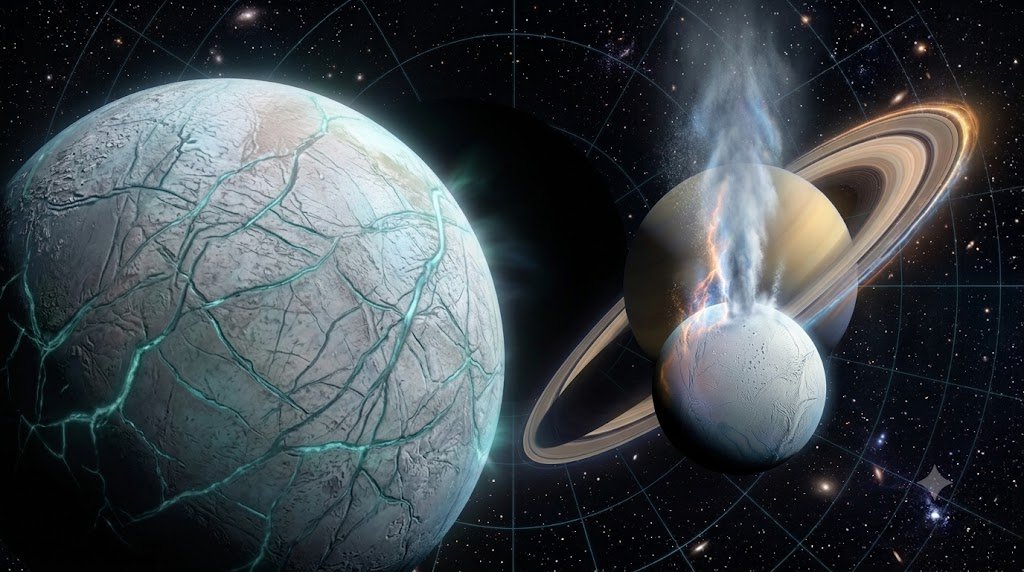
For centuries following the invention of the telescope, astronomers viewed the natural satellites of the outer planets as dead, frozen balls of rock and ice—cold relics suspended in perpetual deep freeze. That paradigm was shattered in March 1979 when Voyager 1 soared past Jupiter and photographed active volcanic plumes erupting hundreds of kilometers above the surface of Io. Today, observational astrobiology recognizes that the most geologically active, hydrologically rich, and potentially habitable environments in our solar system do not reside on sunlit terrestrial planets, but deep beneath the frozen crusts of outer moons. From the tidal infernos of Io to the global subsurface oceans of Europa and Enceladus, the dense hydrocarbon atmosphere of Titan, and the retrograde capture dynamics of Triton, the natural satellites of the giant planets represent a triumphant frontier of planetary astrophysics. This comprehensive guide explores the orbital resonance mechanics, tidal dissipation physics, hydrothermal geochemistry, and cryovolcanic dynamics that animate these alien worlds.
1. The Engine of Outer Moon Activity: Orbital Resonances and Tidal Dissipation
In the outer solar system, sunlight is exceedingly faint. At the orbit of Jupiter (5.2 AU), solar irradiance is just 3.7% of that received by Earth; at Saturn (9.5 AU), it plummets to barely 1.1%. How, then, do worlds smaller than the Earth’s Moon generate sufficient internal thermal energy to power active volcanism, rupture global ice crusts, and melt liquid water oceans hundreds of kilometers deep? The answer is Tidal Dissipation Heating, driven by orbital resonances.
The Laplace Resonance and Forced Eccentricities
A moon in a perfectly circular orbit around a planet experiences a constant gravitational pull, producing an unchanging tidal bulge that causes no internal heating. For tidal heating to occur, the moon’s orbit must be eccentric (elliptical), causing its distance from the massive host planet to continuously vary throughout its orbit.
Normally, tidal friction rapidly circularizes an orbit. However, in the Jovian system, the three innermost Galilean moons—Io, Europa, and Ganymede—are locked into a precise mutual gravitational orbital resonance known as the Laplace Resonance:
For every 1 orbit completed by outer Ganymede (period ~7.15 days), Europa completes exactly 2 orbits (~3.55 days), and inner Io completes exactly 4 orbits (~1.77 days).
Whenever Io laps Europa, and Europa laps Ganymede, the moons experience synchronized, periodic gravitational tugs. These resonant gravitational kicks continuously pump the orbital eccentricities of the moons, preventing their orbits from ever circularizing.
As Io travels along its eccentric orbit around gargantuan Jupiter, the immense gravitational force stretching the moon varies continuously: F_tidal ∝ M_planet · R_moon³ / r³. When Io is at periapsis (closest approach), its solid rocky crust bulges outward toward Jupiter by over 100 meters (330 feet); at apoapsis (furthest distance), the bulge subsides. This relentless gravitational kneading generates colossal frictional shear within Io’s silicate interior, converting orbital kinetic energy into a staggering 100 trillion watts of continuous thermal dissipation.
2. Io: The Hyperactive Silicate Volcanic Inferno
Io is the most volcanically active body in the entire solar system. Its surface is completely devoid of impact craters, proving that continuous volcanic resurfacing completely erases any cratering within mere thousands of years. With over 400 active volcanic calderas (paterae) and fissures, Io’s volcanic output exceeds Earth’s by more than a factor of forty.
Loki Patera and Ultramafic Lava Lakes
Loki Patera is a titanic volcanic depression spanning 202 kilometers across. It represents a vast, active lava lake where a solid crust of solidified basaltic lava periodically founders and sinks into underlying molten magma, exposing radiant lava fountains reaching temperatures exceeding 1,600 Kelvin (1,300°C)—significantly hotter than modern basaltic lavas on Earth. These extreme eruption temperatures indicate that Io’s volcanism is ultramafic, rich in magnesium-iron silicates akin to Earth’s ancient Archean komatiite lavas.
Plumes of gaseous sulfur dioxide (SO₂) and sulfur vapor erupt from vents like Pele at velocities reaching 1 kilometer per second, soaring 300 to 500 kilometers above the surface before freezing into colorful frost. The vibrant mottled yellow, red, orange, and black hues across Io’s surface are not mineral soils; they are diverse allotropes of elemental sulfur and sulfur dioxide frost, creating a planetary palette often described as a “cosmic pizza.”
3. Europa and Enceladus: Global Subsurface Oceans and Astrobiological Potential
While Io’s intense tidal heating cooks all volatile water out of its interior, the moons orbiting slightly further out retain vast water inventories. Europa (orbiting Jupiter) and Enceladus (orbiting Saturn) represent the primary archetypes of Ocean Worlds.
| Feature | Europa (Jupiter) | Enceladus (Saturn) |
|---|---|---|
| Mean Diameter | 3,121 km (Similar to Earth’s Moon) | 504 km (Tiny, size of the United Kingdom) |
| Ice Shell Thickness | 15 – 25 km (Conductive/Convective ice) | 5 km at South Pole; 20–30 km elsewhere |
| Ocean Depth | 60 – 150 km (Contains 2x Earth’s oceans) | 30 – 40 km (Global liquid ocean) |
| Ocean Floor Contact | Direct contact with rocky silicate mantle | Direct contact with porous rocky silicate core |
| Active Plumes | Sporadic water vapor plumes (Hubble) | Continuous cryovolcanic geysers (Tiger Stripes) |
| Detected Geochemistry | Salts (NaCl), CO₂, radiolysis oxidants | H₂O, H₂, CH₄, CO₂, organic macromolecules, phosphates |
Enceladus: Hydrothermal Geochemistry in the Tiger Stripes
Tiny Enceladus is an astrobiological wonderland. In 2005, NASA’s Cassini spacecraft detected spectacular plumes of water ice, gas, and dust erupting from four parallel thermal fractures across its south polar terrain, informally known as the Tiger Stripes (Alexandria, Cairo, Baghdad, and Damascus Sulci).
Cassini performed daring low-altitude flybys directly through these cryovolcanic plumes, tasting their chemical composition with its onboard spectrometers. Cassini discovered:
- Molecular Hydrogen (H₂): Formed by serpentinization reactions where warm ocean water chemically reacts with mantle olivine and pyroxene rocks (Olivine + Water → Serpentine + Magnetite + H₂).
- Methane (CH₄) & Carbon Dioxide (CO₂): Providing key carbon sources. On Earth’s deep ocean floors, methanogenic archaea consume H₂ and CO₂ via the reaction 4 H₂ + CO₂ → CH₄ + 2 H₂O, thriving without sunlight around hydrothermal vents.
- Phosphates (PO₄³⁻): Identified in high concentrations within E-ring ice grains, completing the essential CHNOPS (Carbon, Hydrogen, Nitrogen, Oxygen, Phosphorus, Sulfur) biochemical building blocks of life.
Europa’s Chaos Terrains, Radiolysis, and the Europa Clipper Mission
Europa is enveloped in a bright shell of water ice crisscrossed by intricate reddish fractures known as lineae and disrupted regions termed chaos terrains (such as Conamara Chaos). Chaos terrains feature broken, rotated ice rafts embedded in a frozen slushy matrix, indicating that warm convective ice plumes or buoyant brine pockets breach the surface from below. The red-brown coloration staining the fractures is composed of hydrated magnesium sulfates, sodium chloride (table salt), and complex irradiated sulfur polymers.
Crucially, Europa’s surface is bombarded by high-energy charged particles trapped in Jupiter’s radiation belts. This relentless ionizing radiation breaks surface water ice molecules apart through radiolysis, generating molecular oxygen (O₂), hydrogen peroxide (H₂O₂), and sulfate oxidants. As tectonic convection slowly overturns Europa’s ice shell, these surface oxidants are subducted downward into the subsurface ocean. When oxygen-rich brines mix with reduced minerals and hydrothermal effluents on the rocky sea floor, they create a potent redox gradient (chemical disequilibrium) capable of sustaining chemosynthetic microbial metabolisms without requiring any sunlight.
To directly assess this habitability hypothesis, NASA launched the flagship Europa Clipper spacecraft. Arriving in the Jovian system in 2030, Europa Clipper will perform nearly 50 close flybys skimming within 25 kilometers of Europa’s surface. Equipped with ice-penetrating radar (REASON), high-resolution mapping cameras, infrared spectrometers (MISE), and dust analyzers (SUDA), the mission will measure ocean salinity, determine ice shell thickness, and map organic compounds vented into space.
4. Ganymede and Callisto: Contrasting Giant Moons of Jupiter
Orbiting outside Europa sit Ganymede and Callisto—two colossal worlds that demonstrate the stark differences between differentiated and undifferentiated icy giants.
Ganymede: The Moon with Its Own Magnetic Dynamo
Ganymede is the largest moon in the solar system (diameter 5,268 km), even exceeding the planet Mercury in size. Ganymede is utterly unique among solar system moons: it possesses an active intrinsic dipolar magnetic field generated by an internal liquid iron-nickel core dynamo. Ganymede’s magnetosphere is embedded within Jupiter’s immense magnetosphere, creating mesmerizing dual auroral ovals. Measurements of Ganymede’s auroral rocking by the Hubble Space Telescope confirmed the existence of a deep, saline subsurface ocean under 100 kilometers of dense ice. However, unlike Europa and Enceladus, Ganymede’s ocean is trapped in a “high-pressure ice sandwich” between surface Ice I and high-pressure Ice VI/VII phases at its base, restricting direct chemical interaction with the rocky mantle.
Callisto: The Ancient Undifferentiated Time Capsule
Callisto, the outermost Galilean moon, presents a profound geophysical contrast. Its surface is the most heavily cratered, ancient terrain in the solar system, virtually unaltered by internal tectonism or volcanism for over 4 billion years. Moments of inertia measured by the Galileo spacecraft reveal that Callisto is only partially differentiated: its interior is a sluggish, homogeneous mixture of rock and ice that never experienced runaway thermal melting, serving as a pristine window into the primordial planetesimal feedstock of the outer solar nebula.
5. Titan: Organic Methane Meteorology and Prebiotic Laboratories
Saturn’s largest moon, Titan, is arguably the most Earth-like world in the solar system, despite operating at an ambient surface temperature of 94 Kelvin (-179°C). Titan is the only moon in the solar system endowed with a dense, substantial atmosphere, producing a surface pressure of 1.5 atmospheres (50% greater than Earth’s sea level).
Titan’s atmosphere is 95% molecular nitrogen (N₂) and 5% methane (CH₄). At Titan’s ambient surface temperature and pressure, methane exists precisely near its thermodynamic triple point—enabling methane and ethane to play the exact meteorological role that water plays on Earth:
• Methane Clouds & Rain: Monsoonal convective clouds precipitate liquid methane downpours.
• Fluvial Rivers & Canyons: Liquid hydrocarbons carve dendritic drainage networks into solid water-ice bedrock.
• Lakes & Seas: Vast liquid hydrocarbon seas—such as Kraken Mare (larger than the Caspian Sea) and Ligeia Mare—fill polar depressions.
High in Titan’s stratosphere, solar ultraviolet radiation and energetic magnetospheric electrons dissociate nitrogen and methane, initiating complex photochemical synthesis. The resulting complex organic macromolecules—known as tholins—form an opaque, golden-orange photochemical smog that blankets the moon. In 2028, NASA will launch the revolutionary Dragonfly mission—an eight-rotor nuclear-powered octocopter rotorcraft that will land in Titan’s Shangri-La dune fields in 2034, flying dozens of kilometers across the moon to sample prebiotic organic compounds and probe prebiotic chemical evolution.
6. Triton: Kuiper Belt Capture and Nitrogen Cryovolcanism
Neptune’s primary moon, Triton, is a celestial misfit. It is the only large moon in the solar system that orbits in a retrograde direction (opposite to the planet’s rotation). This anomalous retrograde orbit, combined with a high bulk density and volatile surface composition nearly identical to Pluto, proves that Triton is not a native moon; it is a captured dwarf planet from the Kuiper Belt.
During its gravitational capture by Neptune, violent tidal forces circularized Triton’s initially chaotic, eccentric orbit, generating catastrophic tidal heating that completely melted the moon’s interior into an ancient magma and water ocean. When Voyager 2 flew past Triton in August 1989, it photographed active nitrogen cryogeysers erupting dark plumes of nitrogen gas and sooty organic dust 8 kilometers into the tenuous atmosphere. These geysers are powered by a subsurface greenhouse effect: sunlight penetrates translucent nitrogen ice sheets, vaporizing underlying volatile nitrogen pockets until pressure breaches the crust in spectacular explosive vents.
7. Exotic Moons: Iapetus and Miranda
Beyond the primary ocean worlds lie enigmatic moons shaped by catastrophic impacts and orbital resonance chaos. Saturn’s moon Iapetus is famous for its extreme “two-toned” surface: its leading hemisphere (Cassini Regio) is as dark as asphalt (albedo ~0.04), while its trailing hemisphere is as bright as snow (albedo ~0.6). This extreme dichotomy is driven by a runaway thermal migration feedback: dark dust shed from outer retrograde moon Phoebe coats Iapetus’s leading side, absorbing sunlight, warming the ice, and causing water ice to sublimate and redeposit onto the colder trailing hemisphere. Additionally, Iapetus is girdled along its exact equator by a colossal 20-kilometer-tall mountain ridge, likely the collapsed remnant of an ancient de-orbited sub-satellite ring.
Meanwhile, Uranus’s tiny moon Miranda presents the most intensely deformed, chaotic geology in the solar system. Imaged by Voyager 2, Miranda features giant chevron-shaped tectonic scars known as coronae and Verona Rupes—a towering vertical fault scarp 20 kilometers (12 miles) high, making it the tallest cliff known in the solar system. In Miranda’s low gravity, a dropped stone would take over twelve minutes to fall from the top of the cliff to the bottom.
8. The Subsurface Astrobiological Paradigm
The discovery of subsurface oceans within outer moons has revolutionized astrobiology, fundamentally upending the traditional definition of the circumstellar habitable zone. Traditionally, scientists believed that life required liquid water on a planetary surface illuminated by stellar sunlight. Ocean worlds prove that life may thrive deep beneath tens of kilometers of ice, sustained entirely by internal geothermal heat, tidal kneading, and serpentinization-driven chemical energy gradients.
Because icy moons are vastly more common throughout the cosmos than warm, temperate Earth twins, the total volume of liquid water inside icy moons in our Milky Way Galaxy may exceed the liquid water on terrestrial planets by orders of magnitude. The moons of our solar system are not dead relics of planetary creation; they are vibrant, evolving worlds that could hold humanity’s first confirmation of life beyond the Earth.