NIGHT SKY OBSERVER’S NOTEBOOK · PRACTICAL ASTRONOMY
Finding True North by Following Seven Familiar Stars
Learn how to locate Polaris using the Big Dipper—known as the Plough in Britain—and turn a recognizable star pattern into a reliable guide to the northern sky.
Finding your direction beneath a clear night sky is one of the simplest and most satisfying skills in practical astronomy.
Long before modern navigation systems became widely available, people used recognizable star patterns to understand their surroundings and maintain a sense of direction.
One of the most useful stars for observers in the Northern Hemisphere is Polaris, commonly called the North Star.
Polaris lies close to the direction of Earth’s north celestial pole, making it appear almost stationary while much of the surrounding sky seems to rotate.
However, the North Star is not the brightest star in the night sky, and beginners may find it difficult to identify without a reference.
Fortunately, a familiar group of seven stars provides an easy solution.
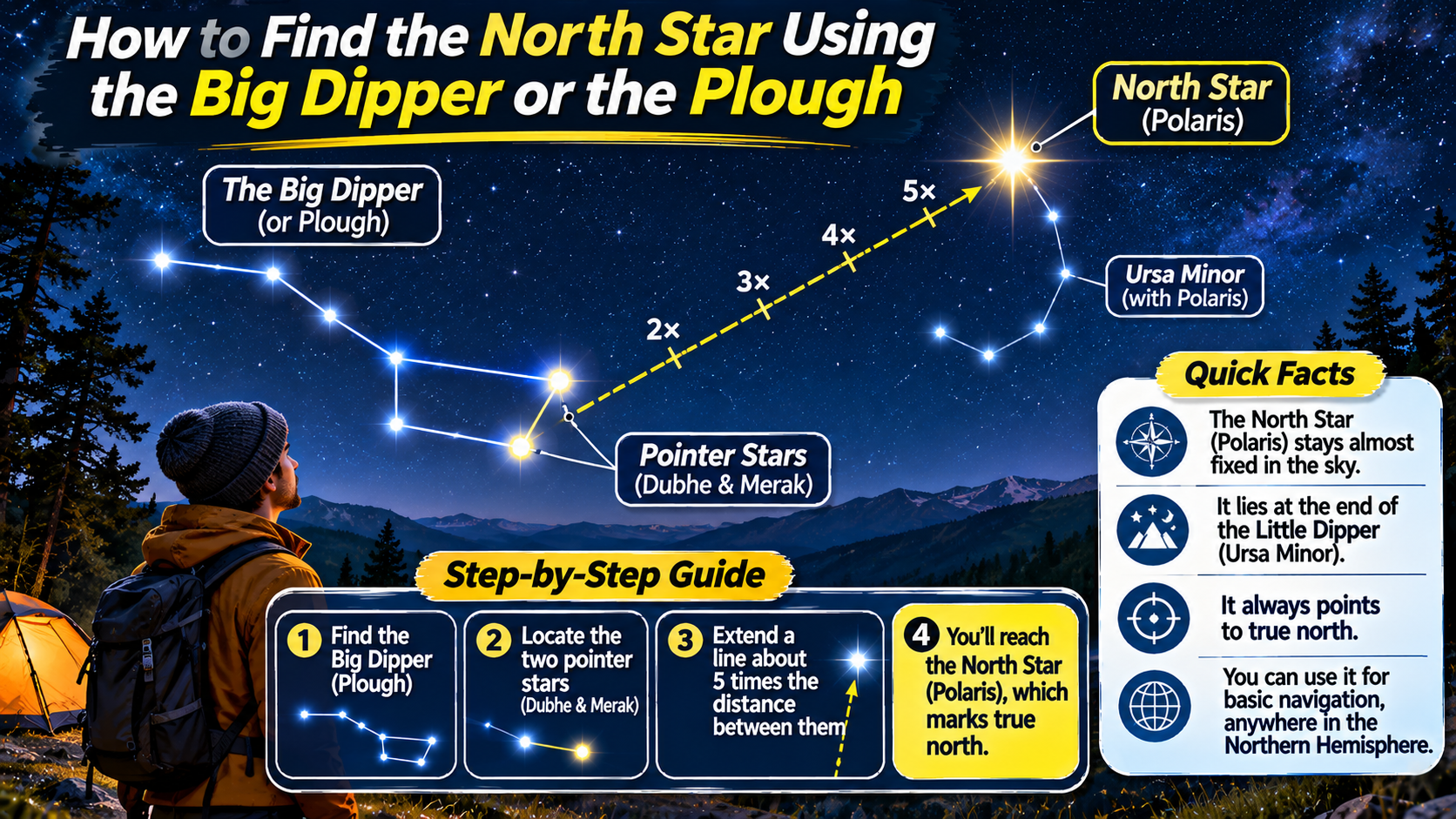
The Big Dipper, known as the Plough in the United Kingdom, contains two pointer stars that lead directly toward Polaris.
Once you understand this relationship, finding north becomes much easier on a clear night.
What Is the North Star?
The North Star is the common name for Polaris, a star located in the constellation Ursa Minor, or the Little Bear.
Polaris is especially important because it lies very close to the north celestial pole.
The north celestial pole is the point in the sky toward which Earth’s rotational axis points in the northern direction.
As Earth rotates, stars appear to move across the sky.
Stars near the celestial pole appear to travel in small circles, while stars farther away trace larger apparent paths.
Because Polaris is close to this pole, its position changes relatively little during the night.
This makes it a useful reference for determining the direction of true north.
Polaris is not exactly at the celestial pole, so it is not perfectly motionless.
Nevertheless, it is close enough to serve as a practical guide for basic outdoor orientation.
What Is the Big Dipper or the Plough?
The Big Dipper is a recognizable pattern of seven bright stars in the constellation Ursa Major, or the Great Bear.
In North America, the pattern is commonly called the Big Dipper because it resembles a large ladle.
In Britain and some other regions, it is known as the Plough.
The seven stars form a distinctive shape consisting of a four-star bowl and a three-star handle.
Although it is often called a constellation, the Big Dipper is technically an asterism.
An asterism is a recognizable star pattern that may form part of a larger constellation.
The Big Dipper is especially useful because its bright stars are relatively easy to recognize when sky conditions are favorable.
Two stars on the outer edge of its bowl provide a direct visual route toward Polaris.
The Two Pointer Stars: Dubhe and Merak
The most important stars for finding Polaris are Dubhe and Merak.
These two stars form the outer edge of the Big Dipper’s bowl, opposite the handle.
Merak is the lower star of this pair when the familiar dipper shape is drawn with its bowl upright.
Dubhe is the upper star in that same orientation.
However, the Big Dipper changes its apparent orientation as the sky rotates, so the stars will not always appear above and below each other.
The essential relationship is the same regardless of orientation.
Imagine a straight line beginning at Merak and continuing through Dubhe.
Extend that line beyond Dubhe for approximately five times the angular distance between the two stars.
You will arrive near Polaris.
This simple technique is the standard beginner method for locating the North Star.
STAR-FINDING REFERENCE / POINTER METHOD
Locate the two stars forming the outer edge of the Big Dipper’s bowl.
↓
Continue from Merak through Dubhe for roughly five times their separation.
↓
Look for a moderately bright star near the end of the imaginary line.
Step-by-Step: How to Find Polaris Using the Big Dipper
Step 1: Choose a Clear Viewing Location
Begin somewhere with an unobstructed view of the northern sky.
Try to avoid bright streetlights, illuminated buildings, and other sources of glare.
Dark surroundings make it easier to recognize star patterns.
Allow your eyes some time to adjust to the darkness.
Step 2: Look for the Big Dipper
Search for a group of seven relatively bright stars forming a bowl with a curved handle.
The pattern may appear upright, tilted, sideways, or upside down depending on the time and season.
Focus on the overall shape rather than expecting it to match a fixed picture.
Step 3: Identify the Outer Edge of the Bowl
Find the two stars forming the side of the bowl farthest from the handle.
These are Merak and Dubhe.
They are commonly called the pointer stars because they indicate the direction of Polaris.
Step 4: Extend an Imaginary Line
Draw a mental line from Merak through Dubhe.
Continue beyond Dubhe for about five times the distance between the pointer stars.
You do not need a measuring instrument.
A rough visual estimate is sufficient for finding the correct region of sky.
Step 5: Locate Polaris
Look for a moderately bright star near the end of your imaginary line.
This is Polaris.
It is also located near the end of the Little Dipper’s handle, although the Little Dipper’s fainter stars can be difficult to see under bright skies.
Step 6: Identify True North
Once you have found Polaris, imagine a vertical line extending from the star toward the horizon.
The point where that line meets the horizon indicates approximately true north.
This method works best when the northern horizon is visible and the sky is clear.
Why the Big Dipper Changes Position During the Night
Beginners sometimes become confused when the Big Dipper appears in a different orientation from the one shown in a star chart.
This happens because Earth rotates on its axis.
As the night progresses, the stars appear to move around the north celestial pole.
The Big Dipper may appear to swing around Polaris.
Its bowl and handle can point in different directions at different times.
However, the relationship between Dubhe, Merak, and Polaris remains essentially unchanged.
The pointer-star method works regardless of the Big Dipper’s apparent rotation.
This is why learning the relationship between the stars is more useful than memorizing a single orientation.
Can You See the Big Dipper All Year?
The visibility of the Big Dipper depends on your latitude and the time of year.
At many northern latitudes, the Big Dipper is circumpolar.
A circumpolar star pattern remains above the horizon throughout its daily apparent rotation.
However, at lower northern latitudes, parts of the Big Dipper may dip below the horizon during certain seasons or times of night.
Polaris itself remains above the northern horizon for observers north of the equator, although it appears very low from locations close to the equator.
As a result, the Big Dipper method is particularly convenient in much of North America, Europe, and other Northern Hemisphere regions.
Observers farther south may need to use other star patterns when the Big Dipper is not visible.
Why Polaris Helps You Find Your Latitude
Polaris is useful for more than identifying north.
Its altitude above the northern horizon provides a close approximation of an observer’s geographic latitude in the Northern Hemisphere.
For example, an observer near latitude 40 degrees north will see Polaris approximately 40 degrees above the northern horizon.
At the North Pole, Polaris appears close to overhead.
Near the equator, it appears close to the northern horizon.
This relationship follows from the geometry of Earth’s rotational axis and the celestial sphere.
Historically, navigators used the altitude of stars, including Polaris, to help estimate latitude.
For precise navigation, corrections and accurate instruments are necessary because Polaris is not exactly at the celestial pole.
| Observer’s Latitude | Approximate Polaris Altitude | Viewing Position |
|---|---|---|
| 10° North | 10° | Low above northern horizon |
| 25° North | 25° | Moderately low |
| 40° North | 40° | Higher in northern sky |
| 55° North | 55° | High above horizon |
| 70° North | 70° | Very high in sky |
Is Polaris the Brightest Star in the Sky?
No. This is one of the most common misconceptions about the North Star.
Polaris is bright enough to be visible under many ordinary night-sky conditions, but it is not the brightest star.
Sirius, located in the constellation Canis Major, is the brightest star in the night sky as seen from Earth.
Polaris is much less conspicuous than Sirius.
That is why the Big Dipper’s pointer stars are so useful.
Rather than searching for the brightest star, observers can follow a recognizable geometric relationship.
This approach is more reliable than judging stars by brightness alone.
What If You Cannot See the Big Dipper?
Clouds, buildings, trees, and seasonal sky positions may prevent you from seeing the Big Dipper.
Another useful Northern Hemisphere pattern is Cassiopeia.
Cassiopeia contains five prominent stars that form a shape resembling the letter W or M.
It lies on the opposite side of Polaris from the Big Dipper in the northern sky.
When the Big Dipper is low or obscured, Cassiopeia may be easier to recognize.
Experienced observers can use the arrangement of Cassiopeia’s stars to estimate the direction of Polaris.
However, the Big Dipper’s Dubhe–Merak pointer method is generally easier for beginners.
Common Mistakes When Searching for the North Star
OBSERVER’S CHECKLIST / AVOID THESE ERRORS
Mistake 1: Choosing the brightest star.
Polaris is not the brightest star in the night sky.
Mistake 2: Following the Big Dipper’s handle.
The correct pointer stars are on the outer edge of the bowl.
Mistake 3: Expecting the dipper to stay upright.
The pattern appears to rotate around the northern sky during the night.
Mistake 4: Extending the line in the wrong direction.
Start at Merak, pass through Dubhe, and continue beyond Dubhe.
Mistake 5: Confusing true north with magnetic north.
Polaris indicates approximately true north, while a magnetic compass points toward magnetic north, which may differ depending on location.
Practical Tips for Your First Stargazing Session
Finding Polaris is easier when you prepare for the viewing conditions.
Choose a night with relatively clear skies and limited cloud cover.
Avoid looking directly at bright lights immediately before observing.
If you need a flashlight, a dim red light can help preserve dark adaptation.
Use a simple star chart to learn the Big Dipper’s shape before going outside.
Remember that star patterns appear at different angles depending on the time of night.
Try identifying the pointer stars first, rather than searching immediately for Polaris.
Once you find the North Star, compare its position with nearby landmarks.
Repeat the exercise on different nights to become familiar with the apparent movement of the sky.
With practice, the process becomes much quicker and more intuitive.
Can the North Star Be Seen from the Southern Hemisphere?
Polaris is generally not visible from locations south of the equator.
Because it lies close to the north celestial pole, it appears below the horizon for most Southern Hemisphere observers.
Southern Hemisphere skywatchers use other methods to estimate south.
One well-known method involves the constellation Crux, commonly called the Southern Cross.
However, identifying the south celestial pole requires a different technique because there is no equally prominent bright star located very close to it.
This difference illustrates how celestial navigation methods depend on an observer’s location on Earth.
Frequently Asked Questions
How do you find the North Star using the Big Dipper?
Locate Merak and Dubhe on the outer edge of the Big Dipper’s bowl. Draw an imaginary line from Merak through Dubhe and extend it about five times their separation to reach Polaris.
Is the Big Dipper the same as the Plough?
Yes. The same seven-star pattern is commonly called the Big Dipper in North America and the Plough in Britain.
Which two stars point to Polaris?
Dubhe and Merak are the two pointer stars used to locate Polaris.
Does the North Star always point north?
Polaris remains close to the north celestial pole, making it a useful approximate indicator of true north for Northern Hemisphere observers.
Is Polaris the brightest star?
No. Sirius is the brightest star in the night sky. Polaris is moderately bright but is especially useful because of its position.
Can I find Polaris without a telescope?
Yes. Polaris and the main stars of the Big Dipper can be seen with the unaided eye under suitable sky conditions.
Why does the Big Dipper appear upside down sometimes?
Earth’s rotation causes the star pattern to appear to move around the north celestial pole, changing its orientation throughout the night.
Final Thoughts
Learning to find the North Star is a useful introduction to practical astronomy and celestial navigation.
The Big Dipper, or Plough, provides one of the easiest methods for locating Polaris.
By identifying Dubhe and Merak and extending an imaginary line through them, observers can find the star that lies close to Earth’s north celestial pole.
Polaris offers a convenient reference for determining approximate true north and understanding the apparent rotation of the night sky.
Its altitude above the horizon also provides a useful approximation of latitude in the Northern Hemisphere.
Although the Big Dipper changes orientation throughout the night, its pointer-star relationship remains consistent.
With a clear sky and a little practice, finding Polaris becomes a simple skill that connects modern stargazers with centuries of astronomical observation.