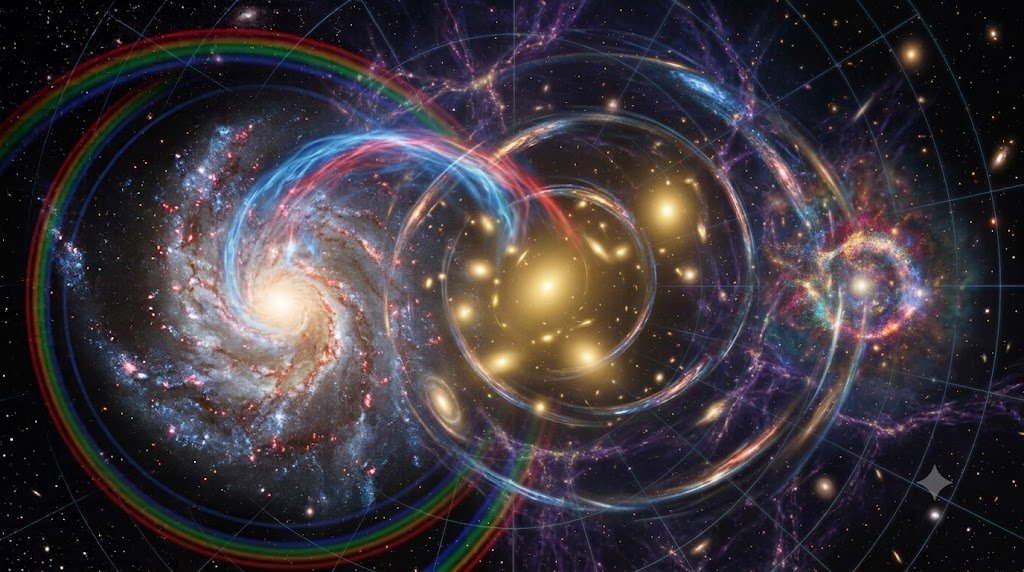
When astronomers lift their gaze beyond individual galaxies and interacting pairs, they encounter the grandest, most gargantuan coherent structures bound by gravity in the history of the universe: Galaxy Clusters. Spanning tens of millions of light-years and containing hundreds to thousands of individual galaxies, trillions of stars, vast atmospheres of multi-million-degree X-ray gas, and enormous reservoirs of invisible dark matter, galaxy clusters represent the colossal peaks of the cosmic density field. Furthermore, clusters do not exist in isolation; they are interconnected nodes within a sprawling cosmic web of large-scale filaments and immense cosmic voids stretching across the observable cosmos. Because their gravitational fields are so immense, galaxy clusters warp the very fabric of spacetime, acting as natural cosmic telescopes through the phenomenon of Gravitational Lensing. This comprehensive treatise investigates the anatomy of galaxy clusters, the physics of the intracluster medium, gravitational lensing methodologies, the Bullet Cluster’s decisive proof of dark matter, and the architecture of the large-scale cosmic web.
1. The Anatomy of Galaxy Clusters: A Triumvirate of Mass
When gazing at optical images of rich clusters such as the Coma Cluster (Abell 1656) or Virgo Cluster, human eyes perceive thousands of radiant spiral, lenticular, and giant elliptical galaxies. However, an empirical mass breakdown of a typical galaxy cluster reveals that visible galaxies are merely cosmic froth on a vast, dark ocean:
• Galaxies (Stellar Mass): Comprise barely 1% to 3% of the cluster’s total mass. Concentrated predominantly in old, red early-type galaxies, dominated by central giant cD ellipticals.
• The Intracluster Medium (ICM): Comprises roughly 10% to 15% of the cluster’s total mass. A diffuse, fully ionized plasma filling the volume between galaxies, heated to tens of millions of Kelvin.
• Dark Matter Halo: Comprises a staggering 80% to 85% of the cluster’s total gravitational mass. A vast, collisionless halo holding the cluster together against thermal and kinetic disassembly. Total cluster masses range from 10^14 to 2 × 10^15 solar masses.
| Observational Probe | Target Component | Physical Mechanism | Key Facilities |
|---|---|---|---|
| Optical / Infrared Spectroscopy | Member Galaxies | Doppler velocity dispersion (Virial Theorem) | VLT, Keck, Subaru, SDSS, DESI |
| X-ray Imaging & Spectroscopy | Intracluster Medium (ICM) | Thermal Bremsstrahlung Emission | Chandra, XMM-Newton, eROSITA |
| Millimeter-Wave Radio | Thermal Electrons in ICM | Thermal Sunyaev-Zel’dovich (tSZ) Effect | Planck, ACT, South Pole Telescope (SPT) |
| Strong Gravitational Lensing | Total Gravitational Potential (Core) | Light deflection into Einstein rings and arcs | Hubble Space Telescope, JWST |
| Weak Gravitational Lensing | Total Gravitational Potential (Outskirts) | Statistical cosmic shear of background galaxies | Euclid, Vera C. Rubin (LSST), Nancy Grace Roman |
2. The Intracluster Medium (ICM) and the Sunyaev-Zel’dovich Effect
The vast space between galaxies in a cluster is not an empty void; it is permeated by the Intracluster Medium (ICM)—a tenuous plasma of ionized hydrogen and helium with trace heavy elements (metallicity ~0.3 solar), possessing densities of barely 10^-3 to 10^-4 particles per cubic centimeter. As gas collapsed into the cluster’s titanic gravitational potential well during its primordial assembly, gravitational potential energy converted into thermal kinetic energy through supersonic virial shocks, heating the ICM to temperatures of 10 to 100 million Kelvin (1 to 10 keV).
Thermal Bremsstrahlung Emission
At these extreme temperatures, electrons are stripped completely from atomic nuclei. When free electrons deflect off positively charged ions, they decelerate, emitting high-energy radiation known as Thermal Bremsstrahlung (Braking Radiation). The emissivity of bremsstrahlung scales with the square of gas density: ε_ff ∝ n_e · n_i · T^(1/2). Consequently, galaxy clusters shine as some of the most luminous X-ray sources in the cosmos (L_X ≈ 10^43 to 10^45 ergs/sec), mapped in breathtaking detail by space telescopes like Chandra and XMM-Newton.
The Thermal Sunyaev-Zel’dovich (SZ) Effect
In 1970, Rashid Sunyaev and Yakov Zel’dovich predicted a subtle interaction between the hot ICM and the primordial relic radiation of the universe: the Cosmic Microwave Background (CMB). When low-energy CMB photons pass through a galaxy cluster, roughly 1% of them collide with the hot, energetic thermal electrons in the ICM.
Through Inverse Compton Scattering, electrons transfer energy to the CMB photons, boosting their frequencies. This produces a characteristic spectral distortion in the CMB spectrum: a slight brightness deficit at radio frequencies below 217 GHz, and an excess at frequencies above 217 GHz. Crucially, the amplitude of the SZ effect is independent of cosmic redshift because as a cluster is moved further away, the CMB radiation field is proportionately denser (scaling as (1+z)⁴), perfectly cancelling cosmic dimming! Consequently, ground-based surveys like the South Pole Telescope (SPT) and the Planck satellite have discovered thousands of pristine galaxy clusters out to the edge of the observable universe using the SZ effect.
3. Gravitational Lensing: General Relativity’s Natural Cosmic Telescopes
In his 1915 General Theory of Relativity, Albert Einstein revealed that mass does not merely attract other objects; mass warps the geometric fabric of four-dimensional spacetime. A beam of light passing near a massive body does not travel along a straight Euclidean line; it follows the curved spacetime geodetic, being bent by a deflection angle: α = 4GM / (c² · b), where b is the impact parameter.
Because rich galaxy clusters represent the most concentrated gravitational mass peaks in the universe, they act as gargantuan Gravitational Lenses, magnifying, distorting, and multiplying the light of background galaxies situated billions of light-years behind them:
Strong Gravitational Lensing: Einstein Rings and Giant Arcs
When a background galaxy, a foreground massive cluster core, and the observer on Earth are aligned in near-perfect collinear symmetry, strong gravitational lensing occurs. The cluster’s gravity acts like an imperfect optical lens, stretching the background galaxy into magnificent, magnified, curved Giant Arcs, multiple split images of the same source, or even a complete closed circular ring known as an Einstein Ring (radius: θ_E = √((4GM / c²) · (D_LS / (D_L · D_S)))).
Strong lensing provides an extraordinary scientific superpower: cosmic magnification. The gravitational lens magnifies background light by factors of 10 to 50, allowing the Hubble and James Webb Space Telescopes to resolve individual stars and primordial galaxies born barely a few hundred million years after the Big Bang that would otherwise remain impossibly dim to detect.
Weak Gravitational Lensing: Mapping Cosmic Shear
In the outer outskirts of galaxy clusters where gravitational curvature is gentler, lensing does not produce dramatic multiple images or arcs. Instead, it imparts a subtle, statistical tangential elongation known as Cosmic Shear onto thousands of faint background galaxies. By measuring the statistical alignment of elliptical distortions across vast fields of view, astronomers can invert the shear field to directly reconstruct a complete, high-resolution two-dimensional map of total cluster mass—revealing the exact spatial distribution of dark matter without relying on any assumptions about light emission.
4. The Bullet Cluster: The “Smoking Gun” Empirical Proof of Dark Matter
For decades, proponents of alternative gravitational frameworks—such as Modified Newtonian Dynamics (MOND)—argued that the missing mass attributed to dark matter was merely an illusion caused by our misunderstanding of gravity at low accelerations. In 2006, Douglas Clowe and his research team delivered a definitive observational refutation of MOND through the study of 1E 0657-56, popularly known as the Bullet Cluster.
The Bullet Cluster consists of two massive galaxy clusters that collided head-on at supersonic speed (approx. 4,500 km/s). When clusters collide, their three mass components behave in radically different ways:
1. Individual Galaxies: Galaxies are tiny compared to the vast intergalactic distances separating them. They passed directly through each other without collision, like two swarms of bees passing unharmed through one another.
2. Intracluster Gas (Baryons): The vast ICM gas clouds—which contain over 85% of all normal baryonic matter—collided violently with supersonic drag and hydrodynamic friction, creating a prominent Mach-3 bow shock. The gas clouds were decelerated and dragged to a halt near the center of mass of the collision.
3. Dark Matter: Being collisionless (interacting solely through gravity), the two vast dark matter halos passed straight through each other without friction, following the collisionless galaxies outward.
When astronomers overlaid weak gravitational lensing maps (which trace where the total mass resides) onto Chandra X-ray maps (which trace where the normal baryonic gas resides), they discovered an undeniable spatial separation: the gravitational mass peaks were completely decoupled from the baryonic gas peaks. If gravity were simply modified Newtonian behavior tied to normal matter, the gravitational lensing peaks would have been centered on the dense X-ray gas where the baryonic mass sits. Instead, the lensing peaks followed the collisionless dark matter halos. The Bullet Cluster stands as the definitive empirical “smoking gun” proving that dark matter is a physical, non-baryonic particle entity.
5. Ram Pressure Stripping and Jellyfish Galaxies
As galaxies travel along high-velocity orbits through the dense, hot intracluster medium, they experience extreme aerodynamic pressure: P_ram = ρ_ICM · v². When ram pressure exceeds the restoring gravitational force of the galactic disk, the cold interstellar gas is forcibly stripped out of the galaxy, forming spectacular trailing tentacles of ionized gas and star-forming clumps.
These systems—informally called Jellyfish Galaxies (such as ESO 137-001 in the Norma Cluster)—display bright, glowing tails spanning over 200,000 light-years into the cluster medium. Ram pressure stripping permanently removes the fuel required for star formation, explaining why galaxy clusters are overwhelmingly dominated by quiescent, “red and dead” elliptical and lenticular galaxies.
7. The Historical Genesis: Fritz Zwicky and the Missing Mass
The realization that galaxy clusters are dominated by dark matter originated in 1933 with Swiss-American astrophysicist Fritz Zwicky. Observing the Coma Cluster (Abell 1656) at Mount Wilson, Zwicky measured the radial Doppler velocities of individual member galaxies using spectroscopy. Applying the classical Virial Theorem—which relates the total kinetic energy of a gravitationally bound system in dynamical equilibrium to its gravitational potential energy (2⟨K⟩ + ⟨U⟩ = 0)—Zwicky calculated the total dynamical mass required to keep the galaxies gravitationally bound.
To his astonishment, Zwicky discovered that the individual galaxies were hurtling through the cluster at blistering velocity dispersions exceeding 1,000 kilometers per second. To prevent these galaxies from escaping into intergalactic space, the Coma Cluster needed to contain at least 400 times more mass than could be accounted for by the visible light of the stars. Zwicky coined the visionary German phrase “dunkle Materie” (Dark Matter) to describe this missing gravitational glue. Although largely dismissed by contemporaries for decades, modern multi-wavelength observations have completely vindicated Zwicky’s profound insight, proving that galaxy clusters are the primordial cradles where dark matter reigns supreme.
8. Baryon Acoustic Oscillations: The Cosmological Standard Ruler
In the hot, dense primordial plasma of the early universe prior to 380,000 years after the Big Bang, photons and baryons (protons and electrons) were tightly coupled into a relativistic fluid. Competing forces of gravitational collapse and outward photon radiation pressure created spherical acoustic sound waves—Baryon Acoustic Oscillations (BAO)—propagating outward through the plasma at over half the speed of light.
When the universe cooled to roughly 3,000 Kelvin at the recombination epoch, electrons bound with protons to form neutral hydrogen atoms, decoupling the photons (which became the Cosmic Microwave Background). The acoustic sound waves froze in place, permanently imprinting a characteristic spatial scale: the Sound Horizon (measuring precisely 147.5 megaparsecs, or roughly 480 million light-years in comoving distance). By measuring the statistical clustering of millions of galaxies and galaxy clusters across cosmological epochs, surveys like the Dark Energy Spectroscopic Instrument (DESI) utilize this frozen sound horizon as a cosmic Standard Ruler, charting the accelerating expansion history of the cosmos and constraining the enigmatic nature of Dark Energy.
6. The Cosmic Web and Large-Scale Structure
Galaxy clusters do not sit in isolated space. When astronomers zoom out to cosmological scales of hundreds of megaparsecs using massive spectroscopic redshift surveys (such as the Sloan Digital Sky Survey – SDSS, and the Dark Energy Spectroscopic Instrument – DESI), an astonishing pattern emerges: the Cosmic Web.
Matter in the universe is arranged in an intricate network resembling neurological synapses or soap foam:
- Nodes: The dense intersections where giant galaxy clusters sit, pulling matter inward from all directions.
- Filaments: Massive bridges of dark matter and warm-hot intergalactic gas (the WHIM) stretching across tens of millions of light-years, along which galaxies channel into cluster nodes.
- Walls and Sheets: Two-dimensional planar membranes of matter bounding empty space, such as the famous Great Wall spanning over 500 million light-years.
- Cosmic Voids: Vast, cavernous, nearly empty expanses spanning 50 to 300 million light-years in diameter, containing virtually no luminous galaxies and densities less than 10% of the cosmic average.
Galaxy clusters and cosmic filaments are the majestic monuments of cosmological time, revealing the profound unity that connects subatomic quantum origins to the largest physical architectures in existence.