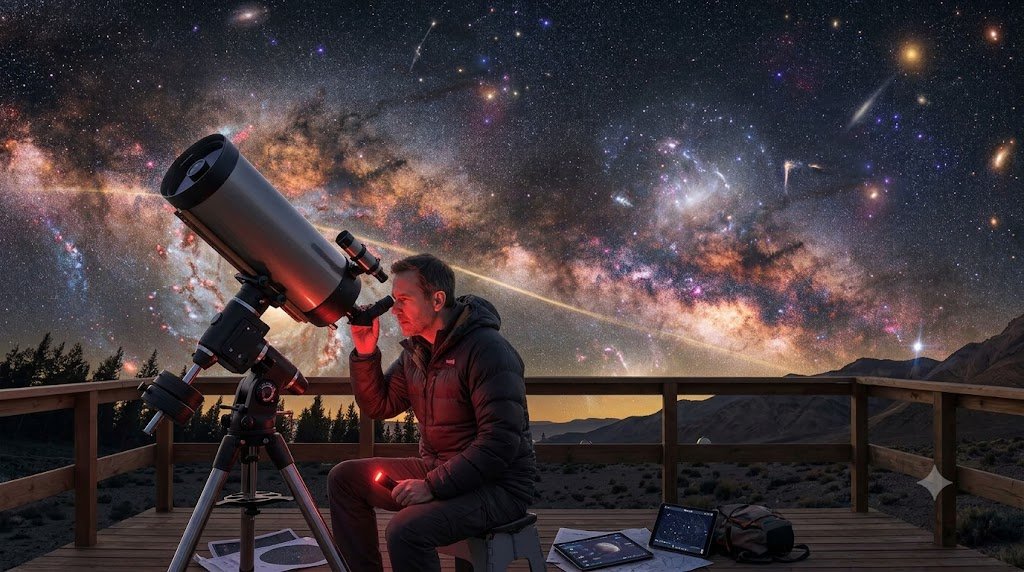
Astronomy is unique among the physical sciences: while particle physicists require multi-billion-dollar underground colliders to probe subatomic reality, amateur astronomers standing in their own backyards can inspect volcanic calderas on the Moon, resolve the cloud belts of Jupiter, and capture photons that departed distant galaxies during the age of the dinosaurs. The fundamental instrument bridging the human eye to these cosmic vistas is the optical telescope. Yet for newcomers and intermediate observers alike, navigating the world of astronomical optics can be daunting. From achromatic refractors and parabolic Newtonian reflectors to Schmidt-Cassegrain catadioptrics, eyepiece focal lengths, apparent fields of view, and Dawes’ limit of angular resolution, telescope selection involves complex optical trade-offs dictated by the laws of classical physics. This comprehensive treatise provides an exhaustive analysis of astronomical optical designs, geometric aberration corrections, magnification equations, eyepiece optical mechanics, and systematic guidance for configuring an optimal visual observing rig.
1. The Cardinal Rule of Telescopes: Aperture Over Magnification
The most pervasive misconception in popular astronomy is that a telescope’s primary purpose is to magnify distant objects. In commercial retail stores, cheap department-store telescopes frequently boast “675x Magnification!” on their packaging. To an optical physicist or experienced astronomer, such claims are immediately recognized as misleading marketing gimmicks. In observational astronomy, Aperture is King.
• Light Gathering Power (LGP): The primary objective lens or mirror acts as a light bucket. The amount of light collected scales quadratically with the diameter (aperture D) of the objective:
LGP ∝ D2
For example, an 8-inch (203 mm) telescope mirror gathers roughly 840 times more light than the dark-adapted human eye (assuming a 7 mm pupil diameter), and over 4 times more light than a 4-inch (102 mm) telescope.
• Diffraction-Limited Angular Resolution (θ): According to wave optics and the Rayleigh criterion, light passing through a circular aperture diffracts, transforming point sources (such as stars) into an Airy disk surrounded by concentric diffraction rings. The theoretical resolving power in arcseconds is defined by Dawes’ Limit:
R (arcseconds) = 116 / D (mm) = 4.56 / D (inches)
A 200 mm aperture can theoretically resolve double stars separated by just 0.58 arcseconds, whereas a 70 mm aperture cannot split stars tighter than 1.66 arcseconds, regardless of how much magnification is applied.
2. Refracting Telescopes (Dioptrics): Glass Lenses and Chromatic Aberration
Refractors represent the classic archetype of the telescope, first turned toward the heavens by Galileo Galilei in 1609. Refractors collect light using an objective lens assembly at the front of a closed optical tube, bending (refracting) incoming parallel light rays to a focal point at the rear.
Chromatic Aberration: The Dispersion Dilemma
Because glass possesses a wavelength-dependent refractive index (dispersion), blue light bends more sharply than red light when passing through a simple convex lens. In a single-element lens, the different colors of the spectrum focus at different focal distances along the optical axis. When an observer focuses on Jupiter or the Moon, bright edges exhibit a distracting purple or violet halo known as chromatic aberration (false color).
| Refractor Design | Lens Architecture | Glass Substrates | Color Correction Quality | Relative Cost |
|---|---|---|---|---|
| Achromatic Doublet | Two cemented or air-spaced lens elements | Crown (low dispersion) + Flint (high dispersion) glass | Brings two wavelengths (red & blue) to common focus; residual violet fringing visible on bright targets | Affordable entry-level |
| ED Doublet (Semi-APO) | Two air-spaced elements including Extra-low Dispersion glass | FPL-51 or FPL-53 synthetic fluorite element | Dramatically reduces chromatic fringing; exceptional sharpness across lunar & planetary surfaces | Moderate intermediate |
| Apochromatic Triplet (APO) | Three matched air-spaced or oil-spaced elements | Fluorite crystal / FPL-53 + lanthanum mating elements | Brings three wavelengths (red, green, blue) to identical focal plane; zero visible false color; razor-sharp stars across full frame | Premium / Professional astrophotography |
Advantages and Limitations of Refractors
Refractors offer outstanding optical contrast because there is no central secondary mirror obstruction in the light path. Planetary contrast on Mars, Jupiter, and Saturn is unrivaled for equivalent apertures. Furthermore, sealed tubes eliminate internal thermal air currents (tube currents) and protect internal surfaces from dust and optical misalignments (collimation is permanently fixed at the factory). However, large glass lenses are heavy, expensive to grind and polish on four to six surfaces, and supportable only at their edges, making refractors above 6 inches (150 mm) prohibitively expensive and mechanically unwieldy.
3. Reflecting Telescopes (Catoptrics): Mirrors and Aperture Economy
Invented by Sir Isaac Newton in 1668 to circumvent chromatic aberration completely, reflecting telescopes use curved mirrors to gather and focus light through reflection rather than refraction. Because reflection obeys the law of equal angles for all wavelengths (θi = θr), reflectors suffer from absolutely zero chromatic aberration.
The Newtonian Reflector and the Dobsonian Mount
The Newtonian reflector utilizes a concave parabolic primary mirror at the base of an open or truss tube. Light travels down the tube, reflects off the primary mirror, converges upward toward the front, and strikes a flat diagonal secondary mirror tilted at 45 degrees, which directs the focal point out through the side of the upper tube into an eyepiece focuser.
When an 8-inch to 16-inch Newtonian optical tube is mounted on a simple, floor-standing alt-azimuth wooden rocker box with Teflon and Formica bearings, it is known as a Dobsonian telescope (popularized by John Dobson in the 1960s). The Dobsonian is universally celebrated as the greatest “aperture-per-dollar” instrument in history: an observer can acquire an 8-inch or 10-inch Dobsonian for the price of a modest 4-inch ED refractor, unlocking spectacular visual views of faint nebulae, distant globular clusters, and spiral galactic arms.
• Coma: While parabolic mirrors eliminate spherical aberration on-axis, off-axis light rays focus at different heights across the focal plane. Stars at the outer edge of wide-field eyepieces appear stretched into tiny, comet-like shapes (comatic flares). Fast Newtonian focal ratios (f/4 to f/4.5) exhibit noticeable coma, which can be completely eliminated using an optical accessory called a Coma Corrector (such as a Tele Vue Paracorr).
• Collimation: Because Newtonian mirrors are mechanically floating in adjustable cells, mechanical vibrations during transit can misalign their optical axes. Checking and adjusting mirror alignment before an observing session using a simple laser collimator or Cheshire eyepiece is a routine, 2-minute maintenance ritual.
4. Catadioptric Telescopes: The Compact Hybrid Champions
Catadioptric telescopes combine lenses and mirrors to fold immense optical focal lengths into remarkably compact, portable tubes. The two dominant designs in amateur astronomy are the Schmidt-Cassegrain Telescope (SCT) and the Maksutov-Cassegrain (Mak).
Schmidt-Cassegrain Optics (SCT)
An SCT features a thin, aspheric glass Schmidt corrector plate at the entrance pupil to correct spherical aberration, a spherical primary mirror at the rear, and a convex secondary mirror mounted on the corrector plate. Light enters through the corrector, bounces off the primary mirror toward the secondary mirror, which magnifies the focal length by roughly 5x and bounces the light back down through a central hole drilled through the primary mirror into the visual back.
Because the optical path is folded three times, an 8-inch SCT achieves a massive 2,000 mm focal length (f/10) inside an optical tube barely 17 inches (43 cm) long! SCTs (such as the classic Celestron C8) represent the ultimate all-around, versatile compromise: compact, highly portable, well-suited for high-magnification lunar and planetary viewing, and easily paired with focal reducers (f/6.3 or HyperStar f/2) for versatile astrophotography.
5. The Mathematics of Astronomical Optics: Focal Ratios and Magnification
Every telescope configuration is governed by fundamental optical formulas linking the telescope optical tube assembly (OTA) to the eyepiece:
1. Focal Ratio (f-number):
f/ratio = Focal Length of Telescope (Ft) / Aperture Diameter (D)
• Fast Scopes (f/4 – f/5): Short focal lengths, wider fields of view, shorter photographic exposure times. Ideal for sweeping large nebulae and star clusters.
• Slow Scopes (f/10 – f/15): Long focal lengths, narrower fields of view, high native magnification. Ideal for lunar craterlets, Saturn’s rings, and double star splitting.
2. Magnification (Power):
Magnification (M) = Focal Length of Telescope (Ft) / Focal Length of Eyepiece (Fe)
A 1,200 mm focal length telescope paired with a 10 mm eyepiece yields: 1200 / 10 = 120x magnification.
3. Exit Pupil: The diameter of the cylinder of light emerging from the eyepiece into your eye pupil:
Exit Pupil (mm) = Aperture (D in mm) / Magnification (M) = Eyepiece Focal Length (Fe) / f-ratio
The human dark-adapted pupil dilates to a maximum of 6 to 7 mm in young adults (roughly 5 mm in older observers). An exit pupil exceeding 7 mm wastes collected light around the iris, while an exit pupil below 0.5 mm becomes uncomfortably dim and reveals distracting eye floaters.
6. Eyepiece Physics: Apparent Fields, Eye Relief, and Optical Design
The telescope optical tube forms a real, inverted image at its focal plane; the eyepiece acts as a sophisticated magnifying loupe that allows your eye to comfortably inspect that real image. Selecting the right eyepiece is just as critical as selecting the telescope itself.
Apparent Field of View (AFOV) vs. True Field of View (TFOV)
The Apparent Field of View (AFOV) is the angular diameter of the circular window seen when looking into the eyepiece, determined by its internal field stop. The True Field of View (TFOV) is the actual slice of the nocturnal sky visible through the telescope:
• Plössl Eyepieces: Standard 50° AFOV. Looking through a Plössl feels like looking down a narrow cardboard tube (“straw effect”).
• Wide-Field Eyepieces (68° – 82°): (e.g., Tele Vue Panoptic, Nagler). Dramatic panoramic viewing where the edges of the field stop recede outside your immediate peripheral vision.
• Ultra-Wide / Hyper-Wide Eyepieces (100° – 110°): (e.g., Tele Vue Ethos, Explore Scientific 100°). Total “spacewalk” immersion: looking into the eyepiece gives the visual illusion of floating untethered directly in open space.
Eye Relief and Barlow Lenses
Eye Relief is the optimal distance from the outer glass surface of the eye lens to your eye where the entire field of view remains visible. Eyeglass wearers require at least 15 to 20 mm of eye relief to observe comfortably without removing their spectacles. While traditional Plössls suffer from microscopic, eyelash-smearing eye relief at short focal lengths (a 4 mm Plössl offers barely 3 mm of eye relief), modern negative-positive designs incorporate an internal Smyth Barlow element to deliver a comfortable 20 mm of eye relief across all focal lengths.
A Barlow Lens is a diverging lens element inserted between the telescope focuser and the eyepiece. A 2x Barlow effectively doubles the focal length of the telescope, doubling the magnification of any eyepiece inserted into it while preserving the comfortable eye relief of longer-focal-length eyepieces. A smart observer possessing three well-spaced eyepieces and a quality 2x Barlow effectively commands six distinct magnification steps across the observing night.
7. Matching the Telescope to the Target: A Strategic Decision Matrix
No single telescope excels at every astronomical discipline. Choosing the ideal optical tool depends upon the observer’s primary observational targets, budget, and physical lifestyle:
| Observing Target | Optimal Optical Design | Recommended Specs | Why This Setup Excels |
|---|---|---|---|
| Planets & Moon | Maksutov-Cassegrain or Apochromatic Refractor | 5″ to 7″ Mak (f/12–f/15) or 4″ APO (f/7–f/8) | Maximum high-contrast MTF resolution, sharp detail on fine lunar rilles, Jupiter’s festoons, Cassini division |
| Deep-Sky Nebulae & Galaxies | Large Dobsonian Reflector | 8″ to 12″ Dobsonian (f/4.5–f/5) | Enormous photon gathering power makes spiral arms of M51, Veil Nebula filaments, and faint galaxies blaze brightly |
| Wide-Field Astrophotography | Fast Apochromatic Triplet Refractor | 70 mm to 90 mm APO Triplet (f/5–f/6) + Field Flattener | Pinpoint star images from corner to corner on full-frame camera sensors; lightweight, stable on tracking equatorial mounts |
| Grab-and-Go Travel | Short-Tube ED Refractor or 90 mm Mak | 72 mm to 80 mm ED refractor on carbon-fiber photographic tripod | Zero cooldown delay, backpack-friendly, ready to observe in under 60 seconds from hotel balconies or mountain campsites |
8. Optical Coatings, Collimation Diagnostics, and Thermal Equilibrium
Achieving diffraction-limited optical performance requires attention to three real-world physical factors often overlooked by beginners:
• Anti-Reflection Multi-Coatings: Modern optical glass elements feature vacuum-deposited multi-layer dielectric anti-reflection coatings (such as magnesium fluoride and titanium oxide). Uncoated glass surfaces reflect roughly 4% of incident light per surface, creating internal ghosting and losing 15% to 20% of light in complex multi-element eyepieces. Broad-band multi-coatings reduce reflection to under 0.2% per surface, maximizing contrast and photon throughput.
• Thermal Equilibrium (Cooldown Time): Large glass mirrors and thick lens elements store heat during daytime storage. When transported into cold nocturnal night air, warm glass creates turbulent boundary-layer convective currents immediately above the optical surface, destroying image sharpness. An 8-inch Newtonian mirror requires roughly 30 to 45 minutes to cool down to ambient air temperature; a 9.25-inch SCT can take over an hour. Installing a 12V boundary-layer cooling fan at the rear of a primary mirror dramatically accelerates thermal equilibrium.
• The Star Test for Collimation: To verify optical alignment, center a bright star (such as Vega or Polaris) at high magnification (200x+) and gently defocus slightly inside and outside of focus. A perfectly collimated telescope reveals symmetrical, concentric circular Fresnel diffraction rings. If the rings are elliptical or squashed off-center, optical alignment screws must be adjusted until the concentric pattern is restored.
By understanding the immutable physics of light reflection, refraction, diffraction, and ocular magnification, the backyard astronomer transcends guesswork. Armed with this optical mastery, every clear night becomes an exhilarating, crystal-clear expedition across the cosmos.