BACKYARD ASTRONOMY / NIGHT-SKY OBSERVATIONS
Why Some Lights in the Night Sky Sparkle While Others Shine Steadily
Discover how Earth’s atmosphere makes stars twinkle, why planets usually appear steadier, and how to recognize the difference during your next stargazing session.
On a clear night, the sky can appear filled with thousands of tiny points of light.
Some seem to sparkle rapidly, changing brightness or even flashing different colors.
Others shine with a steadier glow.
This difference often provides a useful clue about whether you are looking at a distant star or a planet within our solar system.
Stars usually twinkle more noticeably than planets because of the way their light travels through Earth’s atmosphere.
Although both stars and planets are affected by atmospheric conditions, their apparent sizes in the sky are very different.
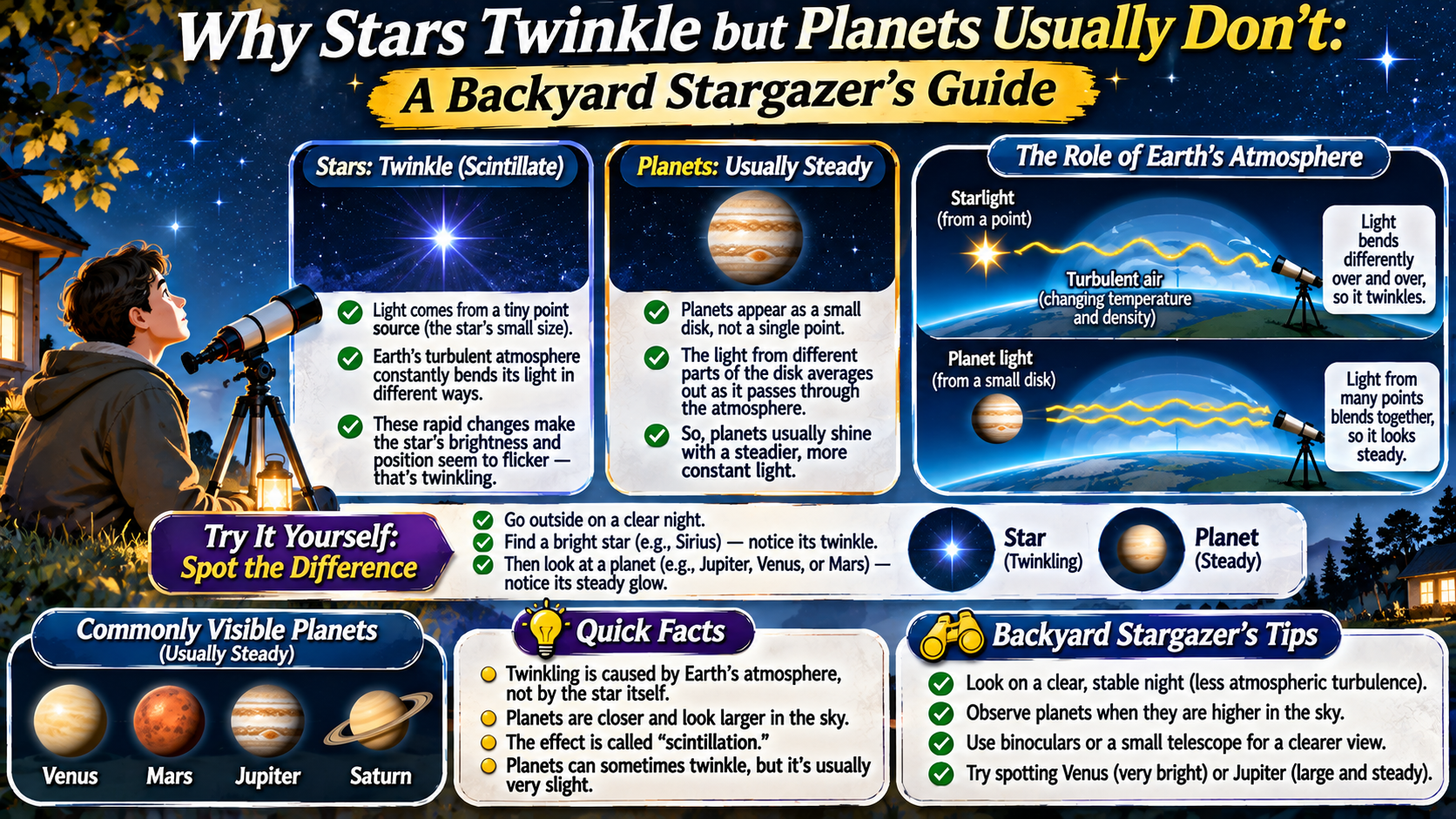
Stars generally appear as extremely tiny points of light, while planets usually present small apparent disks that help average out atmospheric fluctuations.
Understanding this distinction can make backyard stargazing more rewarding and help beginners recognize some of the brightest objects in the night sky.
What Does It Mean When a Star Twinkles?
The scientific term for the apparent twinkling of stars is scintillation.
Scintillation refers to rapid changes in the apparent brightness of a celestial object caused by disturbances in the atmosphere.
Sometimes a star may also appear to shift slightly in position or change color.
These effects occur because starlight passes through moving layers of air before reaching an observer on Earth.
The atmosphere is not perfectly uniform.
Different regions of air have different temperatures and densities, causing light to bend by slightly different amounts.
As these regions move, the path of incoming starlight changes.
The result is the familiar sparkling appearance of many stars.
How Earth’s Atmosphere Makes Stars Twinkle
Light travels through space before reaching Earth’s atmosphere.
Once it enters the atmosphere, it passes through layers of air with changing temperature, pressure, and density.
These differences affect the refractive index of air.
Refraction is the bending of light as it travels through materials with different optical properties.
Small atmospheric variations can change the direction of light by tiny amounts.
Because the atmosphere is constantly moving, these changes occur rapidly.
For a distant star that appears almost point-like, atmospheric disturbances can produce noticeable fluctuations in brightness.
These fluctuations are what observers recognize as twinkling.
ASTRONOMY NOTE / LIGHT & ATMOSPHERE
Stars Do Not Rapidly Change Their Light Output Every Time They Twinkle.
Most visible twinkling is produced by Earth’s turbulent atmosphere rather than rapid changes occurring inside the stars themselves.
Why Stars Appear as Tiny Points of Light
Stars are enormous objects, but they are also extremely far away.
Even nearby stars outside our solar system are separated from Earth by vast distances.
As a result, most stars appear as unresolved points of light when viewed through ordinary backyard telescopes.
Their apparent angular sizes are usually far smaller than the resolving ability of the human eye.
This point-like appearance makes stars especially sensitive to atmospheric fluctuations.
When the atmosphere changes the way light from a star reaches your eyes, the variation can be noticeable because the light comes from an extremely small apparent source.
This is an important reason why stars often sparkle strongly on nights with turbulent atmospheric conditions.
Why Planets Usually Shine More Steadily
Planets are much closer to Earth than stars.
Although they may look like bright points to the unaided eye, planets such as Jupiter, Venus, and Saturn have measurable apparent angular diameters.
Instead of behaving like a single point source, a planet presents a small disk of light.
Different portions of that disk pass through slightly different atmospheric paths.
Fluctuations affecting one part of the disk can be partially averaged out by light arriving from other parts.
This reduces the overall brightness variation perceived by an observer.
Consequently, planets often appear steadier than nearby stars.
However, the effect depends on the planet’s apparent size and atmospheric conditions.
Planets can still twinkle, especially when they are low in the sky.
Why Stars Twinkle More Near the Horizon
Stars close to the horizon often twinkle more strongly than stars positioned high overhead.
The reason is that their light travels through a longer path within Earth’s atmosphere.
When you look directly upward, light generally passes through less atmosphere than when you look toward the horizon.
A longer atmospheric path increases the opportunity for turbulence and refraction to affect incoming light.
This can produce stronger fluctuations in brightness and color.
Near the horizon, stars may appear to flash red, blue, or green as atmospheric dispersion and turbulence influence the light reaching your eyes.
Bright stars such as Sirius can display especially noticeable color changes when positioned low in the sky.
These effects can be dramatic, but they do not mean the star itself is rapidly changing color.
Can Planets Twinkle Too?
Yes. Planets are not completely immune to atmospheric scintillation.
Under turbulent conditions, even bright planets can appear to flicker.
This is particularly likely when a planet is near the horizon.
Its light must travel through a greater thickness of atmosphere, increasing the influence of disturbances.
Planets with smaller apparent disks may also show more noticeable fluctuations than larger-looking planets.
Therefore, the familiar rule that stars twinkle while planets do not is a useful generalization rather than an absolute law.
Observers should consider other clues when identifying objects in the night sky.
How to Tell a Star from a Planet
Twinkling can provide an initial clue, but it is not always enough for a confident identification.
Planets also change their positions relative to the background stars over time.
They appear along a broad path through the sky called the ecliptic, which reflects the approximate plane of Earth’s orbit around the Sun.
Bright planets may appear in different constellations over weeks or months.
Stars, by contrast, maintain nearly fixed patterns relative to one another over ordinary human observing timescales.
A sky chart or astronomy application can help identify the objects visible on a particular night.
BACKYARD OBSERVATION / FOUR USEFUL CLUES
Strong rapid sparkling often suggests a star, especially when the object is high in the sky.
Planets are usually found near the ecliptic rather than randomly distributed across the sky.
Planets gradually shift against the background constellations.
An accurate chart can confirm whether the bright object is a planet or a star.
Stars vs. Planets: Key Differences
| Feature | Stars | Planets |
|---|---|---|
| Light Source | Produce their own visible light | Primarily reflect sunlight |
| Distance | Generally far beyond our solar system | Located within our solar system |
| Apparent Size | Usually point-like | Small measurable disks |
| Twinkling | Often noticeable | Usually less noticeable |
| Position Over Time | Maintain familiar constellation patterns | Move relative to background stars |
How Atmospheric Conditions Affect Stargazing
Not every clear night provides equally steady views of celestial objects.
Atmospheric turbulence can vary with weather patterns, temperature gradients, wind, and local conditions.
Astronomers often use the term seeing to describe the steadiness and sharpness of astronomical images affected by the atmosphere.
Good seeing conditions allow telescopes to produce relatively stable views of planets and other objects.
Poor seeing causes images to shimmer, blur, or change shape rapidly.
Even when the sky is cloudless, turbulence may reduce the detail visible through a telescope.
Observing objects when they are high above the horizon can often improve viewing conditions.
A Simple Backyard Experiment
You can explore the difference between stars and planets without specialized equipment.
Choose a clear evening when a bright planet is visible.
Use a reliable sky chart to identify the planet and a nearby bright star.
Observe both objects for several minutes.
Pay attention to whether one appears to fluctuate in brightness more strongly than the other.
Repeat the observation on another night.
Try comparing objects high in the sky with objects closer to the horizon.
You may notice that atmospheric conditions and observing angles strongly influence how much twinkling occurs.
BEGINNER ASTRONOMY / OBSERVATION ACTIVITY
Try Comparing Two Bright Objects in the Same Part of the Sky.
Record the date, approximate time, weather conditions, and how strongly each object appears to twinkle.
Repeating the experiment helps reveal how changing atmospheric conditions influence what you see.
Why Twinkling Matters to Astronomers
Atmospheric scintillation is more than an interesting visual effect.
It can interfere with precise astronomical measurements.
Ground-based telescopes must observe through Earth’s atmosphere, where turbulence can distort incoming light.
These distortions can reduce image sharpness and affect measurements of celestial objects.
Modern observatories use several techniques to reduce these effects.
Adaptive optics systems can adjust optical components to compensate for some atmospheric distortions.
Space telescopes avoid atmospheric turbulence because they operate above Earth’s atmosphere.
These technologies allow astronomers to obtain clearer observations than would otherwise be possible.
Common Misconceptions About Twinkling Stars
One misconception is that stars twinkle because they are rapidly changing their energy output.
Although stars can vary in brightness for genuine astronomical reasons, ordinary rapid twinkling is usually atmospheric.
Another misconception is that planets never twinkle.
Planets can scintillate, especially near the horizon or during unstable atmospheric conditions.
Some people also assume that a bright, steady object must always be a planet.
Brightness and steadiness alone are not definitive identification methods.
Aircraft, satellites, and other objects can also appear as lights in the night sky.
Combining observations with accurate sky charts provides more reliable results.
Frequently Asked Questions
Why do stars twinkle at night?
Stars twinkle because turbulent layers of Earth’s atmosphere change the path and intensity of starlight reaching an observer.
Why do planets usually not twinkle?
Planets have small apparent disks rather than point-like images, allowing atmospheric brightness fluctuations from different parts of the disk to partially average out.
Can Jupiter or Venus twinkle?
Yes. Both planets can appear to flicker under turbulent atmospheric conditions, particularly when positioned low in the sky.
Why do stars flash different colors?
Atmospheric turbulence and dispersion can cause rapidly changing color effects, especially when bright stars are near the horizon.
Do stars twinkle in space?
Without Earth’s turbulent atmosphere, the familiar atmospheric twinkling effect does not occur. Astronauts observing stars from space do not see them scintillate in the same way.
Is twinkling a reliable way to identify planets?
It is a useful clue, but not a definitive method. Position, movement relative to stars, and sky charts provide better confirmation.
Why is twinkling stronger near the horizon?
Light travels through a longer atmospheric path near the horizon, increasing the influence of turbulence and refraction.
Final Thoughts
The familiar sparkle of stars is largely a result of Earth’s atmosphere.
Moving layers of air bend incoming light and produce rapid changes in apparent brightness.
Stars are particularly affected because they appear as extremely small points of light.
Planets usually shine more steadily because their small apparent disks help average out atmospheric fluctuations.
However, planets can still twinkle when atmospheric conditions are unfavorable.
By observing brightness changes, sky position, and movement over time, backyard stargazers can become more confident at identifying celestial objects.
The next time you look up at the night sky, the difference between a sparkling star and a steadier planet can reveal something fascinating about the atmosphere above you.