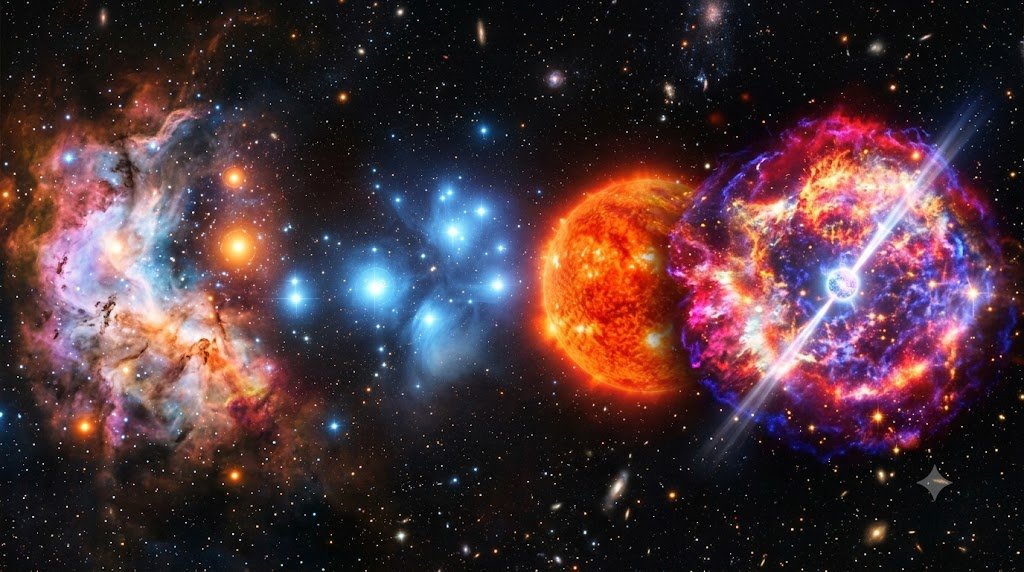
The universe is an unending engine of stellar transformation. From the cold, quiescent expanse of giant molecular clouds to the blistering infernos of thermonuclear core burning, stars are the primary architects of cosmic matter. Every heavy chemical element coursing through planetary crusts, ocean basins, and biological organisms was forged inside stellar furnaces or blasted across space during catastrophic stellar demises. Understanding the lifecycle of stars is the foundational pillar of observational astrophysics. This comprehensive treatise explores the complete evolutionary trajectory of stellar bodies, tracing how gravitational thermodynamics, quantum mechanical degeneracy, and nuclear reaction kinetics govern the birth, enduring vitality, and ultimate death of stars across the cosmos.
1. The Genesis of Stars: Giant Molecular Clouds and the Jeans Instability
All stars begin their physical journey within giant molecular clouds (GMCs). These colossal reservoirs of cold interstellar medium (ISM) span hundreds of light-years and contain masses ranging from thousands to millions of solar masses (M☉). The thermal temperatures within these dark nebulae remain remarkably low, hovering between 10 and 20 Kelvin. This frigid temperature is essential: thermal kinetic energy must be sufficiently subdued so that internal gas pressure cannot counteract the unrelenting inward pull of mutual gravitational attraction.
The mathematical transition from a stable, diffuse gas cloud to a collapsing stellar nursery is dictated by the Jeans Criterion, formulated by British physicist Sir James Jeans. When a localized clump within a nebula exceeds both the Jeans Mass (M_J) and the Jeans Length (R_J), thermal gas pressure loses its equilibrium battle against self-gravity:
The minimum mass required for a gaseous nebular clump to initiate runaway gravitational collapse is expressed as:
M_J ≈ (5 k T / G μ m_H)^(3/2) · (3 / 4 π ρ)^(1/2)
Where T is the kinetic temperature, ρ is the ambient mass density, μ is the mean molecular weight, G is the gravitational constant, and k is the Boltzmann constant. Lower temperatures and higher densities dramatically reduce the threshold mass required for spontaneous fragmentation.
As fragmentation accelerates, the collapsing core divides into hundreds of distinct sub-condensations. During this initial free-fall collapse phase, the cloud is optically thin to infrared radiation, meaning heat generated through gravitational compression escapes freely into space. Consequently, isothermal collapse continues until the core’s interior density rises high enough to trap infrared photons. Once radiation is trapped, adiabatic heating begins, driving internal core temperatures from tens of Kelvin to hundreds of thousands of Kelvin. At this juncture, a luminous, geometrically distinct protostar is officially born.
The Protostellar Phase: T Tauri Variability and Herbig-Haro Outflows
Surrounded by a dense, rotating circumstellar accretion disk, the young protostar continues to draw matter from its natal envelope. During the classic T Tauri evolutionary stage (for stars with masses roughly below 2 M☉), the young stellar object exhibits intense surface magnetic activity, violent ultraviolet stellar winds, and erratic optical luminosity swings. Bipolar relativistic plasma jets blast outwards along the rotation axis, colliding violently with ambient interstellar gas to illuminate spectacular, glowing shock-front structures known as Herbig-Haro (HH) objects. These collimated outflows serve a critical evolutionary purpose: they evacuate excess angular momentum from the accreting disk, permitting inward mass migration onto the central protostellar core.
2. Reaching the Main Sequence: The Ignition of Core Hydrogen Fusion
As gravitational contraction continues over several million years, the core density exceeds 100 grams per cubic centimeter, and the internal core temperature steadily ascends toward 10 to 15 million Kelvin. Under these extreme conditions, the electrostatic Coulomb barrier—which naturally repels positively charged atomic nuclei—is overcome through quantum mechanical tunneling. Hydrogen nuclei (protons) begin fusing into stable helium-4 nuclei, releasing staggering amounts of binding energy via Einstein’s mass-energy equivalence principle (E = mc²).
The moment nuclear fusion generates sufficient outward thermal radiation pressure and gas pressure to balance the crushing inward force of gravity, dynamic contraction ceases completely. The star achieves hydrostatic equilibrium and settles onto the Zero-Age Main Sequence (ZAMS) on the Hertzsprung-Russell diagram:
dP(r) / dr = – G · M(r) · ρ(r) / r²
This equation mandates that the inward gravitational weight of any spherical shell within the star must be precisely counterbalanced by the outward gradient of total internal pressure (gas pressure plus radiation pressure). If the core cools slightly, gravity compresses it, driving up core temperature and fusion rates until equilibrium is naturally restored.
The Mass-Luminosity Relationship and Main-Sequence Lifespans
A star’s total mass is the single most decisive variable governing its entire evolutionary path, surface temperature, color, internal energy transport mechanisms, and total operational lifespan. Massive stars burn through their nuclear fuel at catastrophically accelerated rates compared to low-mass stars. The empirical Mass-Luminosity Relation states that for intermediate and high-mass main-sequence stars, luminosity scales steeply with mass: L ∝ M^(3.5).
| Spectral Class | Typical Mass (M☉) | Core Fusion Mechanism | Main-Sequence Lifespan | Ultimate Evolutionary Fate |
|---|---|---|---|---|
| O-Type Blue Supergiant | 20 – 60 M☉ | CNO Cycle (Catalytic) | 3 – 10 Million Years | Core-Collapse Supernova (Neutron Star / Black Hole) |
| B-Type Blue-White Star | 3 – 16 M☉ | CNO Cycle Dominant | 50 – 200 Million Years | Type II Supernova or Massive White Dwarf |
| A-Type White Star | 1.5 – 2.5 M☉ | CNO / Proton-Proton Mix | 1 – 2 Billion Years | Carbon-Oxygen White Dwarf (Planetary Nebula) |
| G-Type Yellow Dwarf (Sun) | 0.8 – 1.2 M☉ | Proton-Proton Chain | 10 Billion Years | Carbon-Oxygen White Dwarf (Planetary Nebula) |
| M-Type Red Dwarf | 0.08 – 0.45 M☉ | Proton-Proton (Convective) | 100 Billion – Trillions | Helium White Dwarf (Slow Degenerate Cooling) |
3. Post-Main-Sequence Evolution: The Red Giant Branch and Core Helium Burning
Eventually, core hydrogen reserves become completely exhausted, converted entirely into an inert, non-fusing “ash” of helium nuclei. Deprived of nuclear radiation pressure at its center, the inert helium core undergoes gravitational contraction, while the surrounding hydrogen-rich shell experiences sudden compression and heats up. This triggers furious hydrogen shell burning in a thin spherical shell immediately surrounding the dead core.
The enormous thermal energy pumped out by hydrogen shell burning expands the star’s outer envelope by factors of hundreds. As the outermost atmospheric layers swell to engulf millions of kilometers of orbital radius, they radiate energy over a vastly larger surface area, causing outer effective temperatures to plunge into the reddish 3,000 to 4,000 Kelvin spectrum. The star ascends the Red Giant Branch (RGB) of the H-R diagram, transforming into a luminous red giant capable of engulfing close-in orbiting planets.
The Helium Core Flash versus Smooth Core Transition
For stars with masses between roughly 0.8 and 2.0 M☉, the contracting helium core becomes extremely dense (approaching 10^6 g/cm³) before temperatures reach the threshold required for helium fusion. Under these extreme densities, the electrons in the core are crushed into a state of quantum electron degeneracy governed by the Pauli Exclusion Principle. In degenerate matter, pressure depends solely on electron density rather than temperature.
When the core temperature finally climbs to approximately 100 million Kelvin, helium fusion ignites via the Triple-Alpha Process (3 ⁴He → ¹²C + γ). In ordinary ideal gas, rising temperature causes immediate thermal expansion, which cools the core and self-regulates fusion. In degenerate matter, however, the temperature spikes wildly without causing expansion. This unleashes a catastrophic runaway thermonuclear explosion known as the Helium Core Flash. Within minutes, the core produces energy outputs rivaling an entire galaxy until thermal energy finally breaks electron degeneracy, expanding the core into a stable, non-degenerate helium-burning horizontal branch star.
4. The Asymptotic Giant Branch and the Expulsion of Planetary Nebulae
Once helium in the core is entirely consumed, converted into an inert core of carbon and oxygen, history repeats itself on a grander scale. The carbon-oxygen core contracts, while double shell burning establishes itself: an inner helium-burning shell wrapped inside an outer hydrogen-burning shell. The star ascends the Asymptotic Giant Branch (AGB), growing even larger and more luminous than during its initial red giant stage.
On the AGB, the star experiences powerful thermal pulses and violent convective dredge-up events that dredge heavy synthesized carbon, nitrogen, and s-process elements from the interior directly to the stellar surface. Massive radiation pressure acting upon newly synthesized silicate and carbon dust grains drives ferocious, supersonic stellar winds, stripping the star of its outer gaseous atmosphere at rates reaching 10^-4 M☉ per year.
Over several tens of thousands of years, the dying giant ejects its entire convective hydrogen-helium envelope into interstellar space. The blistering, exposed degenerate carbon-oxygen core—radiating ultraviolet temperatures in excess of 100,000 Kelvin—ionizes the expanding gas shells, creating an ethereal, glowing Planetary Nebula (such as the Ring Nebula M57 or the Helix Nebula). The ejected shells enrich the surrounding galaxy with carbon, nitrogen, and oxygen, providing the raw chemical seeds for subsequent generations of solar systems and terrestrial worlds.
5. High-Mass Star Evolution: Multi-Shell Onion Burning and Core Collapse
For stars exceeding 8 solar masses, stellar evolution follows an incomparably more violent and complex pathway. Massive stars possess sufficient gravitational mass to heat their contracting cores well beyond the temperatures achievable by low-mass stars. Rather than ending at carbon and oxygen, massive stars systematically ignite progressively heavier nuclear fuels in succession:
- Carbon Burning (~600–800 Million K): Produces neon, sodium, and magnesium; lasts several hundred years.
- Neon Photodisintegration (~1.2–1.5 Billion K): High-energy gamma photons knock alpha particles from neon nuclei, fueling magnesium and oxygen production; lasts mere months.
- Oxygen Burning (~1.5–2.0 Billion K): Synthesizes silicon, sulfur, phosphorus, and chlorine; lasts several months.
- Silicon Burning (~3.0–3.5 Billion K): Reaches the ultimate nuclear terminus, building nickel-56 which rapidly beta-decays into cobalt-56 and stable iron-56; lasts a few days or hours.
The interior architecture of an evolved supergiant resembles an intricate concentric onion. At the outermost perimeter lies unburned hydrogen, followed deeper inward by burning shells of hydrogen, helium, carbon, neon, oxygen, and silicon, all resting atop an inert, ultra-dense iron-nickel core.
The Iron Catastrophe and the Type II Supernova Detonation
Iron-56 possesses the highest nuclear binding energy per nucleon of any atomic nucleus in the universe. Consequently, fusing iron requires an injection of net external energy rather than yielding energy (it is strictly endothermic). When the accumulating iron core exceeds the physical Chandrasekhar Mass Limit of approximately 1.44 M☉, electron degeneracy pressure fails catastrophically under the tremendous weight of the overlying stellar mantle.
Within a fraction of a second, the entire iron core collapses inward at approximately 23% the speed of light. Electrons are crushed into protons through electron capture (p + e⁻ → n + ν_e), neutralizing the core into an unimaginably dense sphere of degenerate neutrons while liberating an enormous torrent of neutrinos. When the core density reaches nuclear saturation density (~3 × 10^14 g/cm³), the strong nuclear force becomes fiercely repulsive, halting the collapse with an elastic rebound. This creates a titanic outward supersonic shock wave that rips through the infalling outer layers, blasting the star apart in a blinding Type II Core-Collapse Supernova that shines with the brilliance of billions of suns.
6. The Degenerate Graveyard: White Dwarfs, Neutron Stars, and Black Holes
The physical corpse left behind by stellar evolution depends entirely on the progenitor star’s initial zero-age main sequence mass and the final mass of its non-ejected degenerate core:
White Dwarfs: Quantum Electronic Crystallization
Stars born with masses below approximately 8 M☉ end their lives as White Dwarfs. Compacting roughly 0.6 to 1.2 solar masses of carbon and oxygen into an Earth-sized sphere, white dwarfs are sustained permanently against further gravitational collapse by electron degeneracy pressure. Having completely ceased nuclear fusion, white dwarfs do not generate energy; they simply radiate their residual thermal heat over trillions of years, gradually crystallizing into ultra-dense metallic lattices of carbon and oxygen (degenerate “black dwarf” relics).
Neutron Stars and Pulsars: Nuclear Density Regimes
When stars with initial masses between 8 and 25 M☉ detonate as supernovae, their collapsed remnant forms a Neutron Star. Packing 1.4 to 2.1 solar masses into a sphere barely 20 kilometers in diameter, matter within a neutron star is supported against gravity by neutron degeneracy pressure and the repulsive short-range strong nuclear interaction. Neutron stars exhibit rotational speeds of hundreds of rotations per second and surface magnetic fields exceeding trillions of Gauss. Rapidly spinning magnetized neutron stars emit collimated beams of electromagnetic synchrotron radiation, sweeping across the cosmos like cosmic lighthouses known as pulsars.
Stellar-Mass Black Holes: The Ultimate Singularity
If the progenitor star’s initial mass exceeds approximately 25 to 30 M☉, the remnant core’s mass surpasses the Tolman-Oppenheimer-Volkoff (TOV) limit (roughly 2.2 to 3.0 M☉). Under such colossal gravitational weight, no known fundamental physical force—neither electron nor neutron degeneracy—can withstand the inward collapse. The remnant core collapses completely past its Schwarzschild Event Horizon, collapsing into an infinitesimally small gravitational singularity where general relativity and quantum mechanics converge: a stellar-mass black hole.
7. Observing Stellar Evolution: Backyard Astronomy to World-Class Spectrometry
Amateur stargazers and professional astrophysicists alike can witness every major stage of the stellar lifecycle directly through optical instruments. The Orion Nebula (Messier 42) provides an accessible, pristine view of active star formation, where infant stars illuminate turbulent gas clouds barely 1,300 light-years away. Nearby, the red supergiant Betelgeuse in Orion’s shoulder displays the swollen, pulsating death throes of a massive star nearing core collapse. Meanwhile, the Ring Nebula (M57) in Lyra and the Dumbbell Nebula (M27) in Vulpecula showcase the radiant planetary nebulae cast off by intermediate-mass stars, complete with their faint, blistering central white dwarf cores.
By learning to decode the color, spectral lines, and luminosity variations of celestial bodies, astronomers unlock the deep chronology of cosmic evolution. Stars are not eternal fixtures of the heavens; they are dynamic, energetic engines whose continuous cycles of birth, nucleosynthesis, and explosive death ensure the eternal fertility and complexity of our expanding universe.