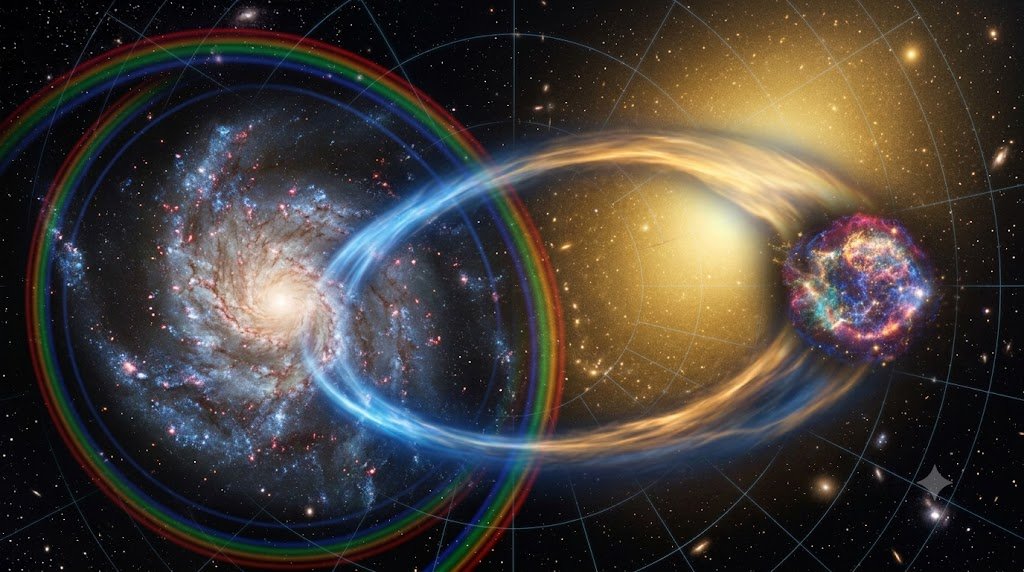
Until the landmark observations of Edwin Hubble in the early 1920s at the Mount Wilson Observatory, the prevailing cosmological consensus held that the Milky Way encompassed the entirety of the observable universe. Faint, diffuse spirals observed through telescopes were dismissed as mere “spiral nebulae” situated within our own galactic boundaries. Hubble’s identification of Cepheid variable stars in the Andromeda Nebula (M31) shattered this geocentric and galactocentric conceit, proving that these spiraling whirlpools of light were autonomous “island universes” separated from us by millions of light-years of intergalactic void. Today, observational astrophysics recognizes that galaxies are the fundamental building blocks of the large-scale universe—colossal gravitationally bound systems containing between millions and trillions of stars, vast interstellar gas reserves, stellar remnants, and enveloping halos of unseen dark matter. This comprehensive treatise investigates galactic morphology, the structural classification of the Hubble Tuning Fork, stellar populations, internal kinematics, and the dynamic evolutionary pathways that transform galaxies across cosmic eons.
1. The Hubble Sequence: Taxonomic Anatomy of Galaxies
In 1926, Edwin Hubble formulated a morphological classification system that remains the standard descriptive baseline in extragalactic astronomy: the Hubble Sequence, often visualized as the iconic Hubble Tuning Fork Diagram. While Hubble initially hypothesized that this sequence represented an evolutionary track along which galaxies progressed from left to right (hence the enduring historical terms “early-type” and “late-type” galaxies), modern astrophysics recognizes that morphology reflects assembly history, gas dynamics, and merger frequency rather than a simple linear age sequence.
• Elliptical Galaxies (E0 – E7): The handle of the tuning fork. Ellipsoidal, featureless systems lacking prominent gas disks, classified according to apparent ellipticity: E = 10 · (1 – b/a), where a and b are the semi-major and semi-minor axes. E0 galaxies appear circular, while E7 represents the most elongated visible ellipticals.
• Lenticular Galaxies (S0 / SB0): The junction point of the fork. Intermediate systems possessing a prominent stellar disk and central bulge, but lacking active star-forming spiral arms and rich cold gas reservoirs.
• Normal Spiral Galaxies (Sa, Sb, Sc): The upper prong of the fork. Characterized by winding spiral arms emerging symmetrically from a central spherical bulge.
• Barred Spiral Galaxies (SBa, SBb, SBc): The lower prong of the fork. Distinguished by a rigid, linear stellar bar cutting through the central nucleus, with spiral arms emanating from the bar ends.
• Irregular Galaxies (Irr I & Irr II): Asymmetric, disrupted systems that do not conform to rotational or ellipsoidal symmetry.
| Galactic Class | Bulge-to-Disk (B/D) | Gas & Dust Fraction | Dominant Stellar Population | Primary Kinematic Support |
|---|---|---|---|---|
| Ellipticals (E0-E7) | Pure spheroid (No disk) | < 1% (Hot X-ray coronal gas only) | Old Population II (Red, metal-poor to rich) | Random Velocity Dispersion (σ) |
| Lenticulars (S0) | High (~0.5 – 1.0) | Very Low (< 2%) | Intermediate to Old Population II | Co-rotation in disk + velocity dispersion |
| Spirals (Sa) | Prominent (~0.3 – 0.5) | Moderate (~2 – 5%) | Mixed Pop I & II (Tightly wound arms) | Coherent Disk Rotation (V_rot > σ) |
| Spirals (Sc) | Diminutive (< 0.1) | High (~10 – 25%) | Young Population I (Open, knotty arms) | High Rotational Support (Thin cold disk) |
| Irregulars (Irr) | Undefined / Chaotic | Very High (> 30%) | Extremely Young, Vigorous Starbursts | Turbulent Gas Dispersion & Tidal Shear |
2. Spiral and Barred Architectures: Gas Dynamics and Secular Evolution
Spiral galaxies represent the pinnacle of cosmic aesthetic elegance. Within their thin, rotating disks, interstellar cold molecular gas (primarily H₂ and CO) collapses into brilliant stellar nurseries, illuminated by the ionizing ultraviolet light of short-lived O and B-type stars. The winding spiral structure itself is not a rigid material arm (if it were, differential galactic rotation would tightly wind and destroy the arms within a few rotations—the classic Winding Problem). Instead, spiral patterns are sustained by Quasi-Stationary Spiral Density Waves, formalized by Chia-Chiao Lin and Frank Shu.
Density Wave Physics: Cosmic Traffic Jams
A spiral arm is a localized gravitational wave of enhanced matter density revolving around the galactic center at a constant pattern speed (Ω_p). As interstellar gas clouds orbit within the disk, they periodically overtake the slower-moving density wave pattern. Entering the gravitational wave crest, the gas experiences sudden gravitational acceleration, creating a sharp hydrodynamic shock front along the inner edge of the spiral arm.
This compression squeezes giant molecular clouds past their critical Jeans Mass, triggering widespread gravitational collapse and birthing thousands of luminous blue OB associations and glowing H II emission nebulae. Because massive O and B stars live for only 5 to 30 million years, they perish in supernova explosions before they can travel across to the other side of the wave crest. Consequently, spiral arms appear intensely blue, knotty, and radiant, while the inter-arm regions are populated by older, redder, long-lived stars that survive multiple transits through the density wave cycles.
Bar Formation and Gravitational Torques
Over two-thirds of all spiral galaxies in the local universe—including our own Milky Way—possess prominent central stellar bars. Bars arise through dynamical disk instabilities when the self-gravity of a cold, rotationally supported stellar disk overcomes rotational shear. Once formed, a stellar bar exerts powerful non-axisymmetric gravitational torques on the surrounding interstellar gas.
These torques sap angular momentum from orbiting gas clouds, funneling vast streams of cold molecular gas inward along the leading edges of the bar directly into the galactic nucleus. This gas inflow fuels vigorous circumnuclear starburst rings and feeds the central supermassive black hole. Bar-driven secular evolution demonstrates that galaxies can alter their morphology internally over billions of years without requiring external environmental collisions.
3. Elliptical Galaxies: Dynamically Hot Remnants of Cataclysmic Mergers
In stark contrast to cold, orderly, rotating spiral disks, elliptical galaxies are dynamically “hot” stellar systems. Their constituent stars do not orbit in an organized planar disk; rather, they move along chaotic, randomly oriented, eccentric three-dimensional orbits, supported against gravitational collapse by velocity dispersion (σ) rather than net angular momentum.
The “Red and Dead” Paradigm: Quenched Star Formation
Elliptical galaxies are predominantly populated by ancient, low-mass Population II stars, giving them a distinct yellow-red spectral appearance. Because they have depleted or expelled their reservoirs of cold, dense interstellar gas, their star formation rates are virtually zero. What gas does exist within giant ellipticals is heated to tens of millions of Kelvin by supernova shockwaves and virially trapped inside the deep gravitational potential well, emitting copiously in the soft X-ray spectrum as a diffuse hot corona.
Ellipticals span an extraordinary mass spectrum, from diminutive Dwarf Ellipticals (dE) containing barely 10^7 stars to colossal cD Supergiant Ellipticals at the cores of rich galaxy clusters. A prime example is M87 in the Virgo Cluster, which spans over 120,000 light-years in diameter, harbors over 15,000 globular clusters (compared to ~150 in the Milky Way), and weighs in excess of several trillion solar masses.
The Merger Hypothesis: Hierarchical Galaxy Formation
How did giant elliptical galaxies form? According to the Lambda-Cold Dark Matter (ΛCDM) cosmological framework, ellipticals are the natural products of hierarchical major mergers. When two gas-rich spiral galaxies of comparable mass collide, their delicate rotational disks are destroyed by mutual gravitational tidal forces. Violent gravitational relaxation scrambles the ordered circular orbits of stars into a randomized three-dimensional triaxial ellipsoid.
During the collision, the colliding gas clouds experience violent hydrodynamic shocks, triggering a colossal, brief burst of star formation (a starburst). Rapid gas consumption, coupled with ferocious relativistic energy feedback from the merging supermassive black holes (Active Galactic Nuclei), blows out the remaining cold gas, permanently quenching future star formation and leaving behind a quiescent, reddish elliptical remnant.
4. Scaling Relations: Tully-Fisher, Faber-Jackson, and the Fundamental Plane
Galaxies are governed by remarkably precise empirical scaling relations that connect their internal kinematics directly to their total intrinsic luminosities. These scaling relations are foundational pillars of the Cosmic Distance Ladder and provide undeniable proof of the pervasive influence of dark matter halos.
The Tully-Fisher Relation for Spiral Galaxies
Formulated in 1977 by R. Brent Tully and J. Richard Fisher, the Tully-Fisher Relation correlates the total intrinsic optical or infrared luminosity (L) of a spiral galaxy with the width of its 21-centimeter neutral hydrogen (H I) emission line, which measures the galaxy’s maximum rotational velocity (V_max):
L ∝ (V_max)^α (where α ≈ 3.5 to 4.0 depending on photometric band)
Because total luminosity tracks stellar mass, and rotational velocity tracks total dynamical mass (baryons + dark matter), this tight power-law relation enables astronomers to deduce a spiral galaxy’s absolute luminosity simply by measuring its Doppler line broadening. Comparing absolute luminosity to observed apparent brightness immediately yields the precise extragalactic distance via the inverse-square law.
The Faber-Jackson Relation and the Fundamental Plane for Ellipticals
For elliptical galaxies, which lack organized rotational velocities, Sandra Faber and Robert Jackson discovered an analogous relationship in 1976: the Faber-Jackson Relation: L ∝ σ^4, where σ is the central stellar velocity dispersion. Refinements in the 1980s incorporated the effective physical radius (R_e) and mean surface brightness (⟨I⟩_e), defining the two-dimensional Fundamental Plane of elliptical galaxies:
This extraordinarily tight bivariate correlation reflects the underlying virial equilibrium of elliptical stellar systems, serving as an exceptional standard ruler for mapping peculiar galaxy velocities and cosmic expansion flows across hundreds of megaparsecs.
5. Irregular and Interacting Galaxies: Cosmic Laboratories of Starbursts
Roughly 3% of galaxies defy the orderly symmetries of the Hubble sequence, designated as Irregular Galaxies (Irr). Classified broadly into Irr I (displaying resolved star clusters, H II regions, and disordered gas structures) and Irr II (heavily disturbed, chaotic morphologies with high dust obscuration), irregular galaxies are typically lower-mass dwarf systems or galaxies undergoing catastrophic gravitational collisions.
Tidal Interactions and the Antennae Galaxies
When galaxies pass close to one another, differential gravitational pull draws out vast, arching streamers of stars and gas known as tidal tails. The classic archetype is the Antennae Galaxies (NGC 4038 / NGC 4039), a pair of colliding spirals currently caught in a mutual gravitational embrace. Two colossal tidal plumes spanning hundreds of thousands of light-years flare outwards into intergalactic space, while at the center, the intersecting interstellar gas disks have collided with supersonic speed.
This supersonic compression triggers intense starburst activity, igniting thousands of brilliant, ultra-compact “super star clusters”—dense agglomerations of hundreds of thousands of newly formed young stars that represent the modern analogs of ancient globular clusters. Interacting galaxies demonstrate that morphology is not static; it is fluid, shaped by continuous cosmic choreography and gravitational perturbation.
6. Lenticular (S0) Transition Systems and Environmental Quenching
Lenticular galaxies (S0) represent the critical missing link in galactic taxonomy. Possessing a smooth, disk-like stellar distribution with a central bulge but devoid of spiral arms, S0 galaxies are transitional systems that have lost their star-forming vitality. In dense galaxy cluster environments, two primary mechanisms drive the transformation of spirals into lenticulars:
First, Ram Pressure Stripping occurs when a spiral galaxy plunges at thousands of kilometers per second through the hot, dense intracluster medium (ICM). The aerodynamic drag forces strip the diffuse cold neutral hydrogen gas out of the disk, leaving behind a sterile stellar disk unable to form new stars. Second, Starvation (or Strangulation) strips the diffuse halo reservoir of gas that continuously replenishes the disk. Once the existing cold gas in the disk is consumed by star formation, the spiral arms fade away over a few billion years, leaving behind a quiescent, smooth lenticular structure.
7. The Dark Matter Scaffolding of Galactic Architectures
Perhaps the most revolutionary insight of modern extragalactic astrophysics is that all visible luminous galactic components—every star, planet, gas cloud, and glowing nebula—comprise merely 10% to 15% of a galaxy’s total mass. The overwhelming majority of every galaxy consists of a massive, spherical, collisionless Dark Matter Halo extending far beyond the optical boundaries of the visible disk.
Pioneering spectroscopic observations by Vera Rubin and Kent Ford in the 1970s revealed that the rotational velocities of spiral galaxies do not decline with distance from the center in accordance with Newtonian Keplerian mechanics (which predicts V(R) ∝ 1/√R outside the luminous core). Instead, galactic rotation curves remain completely flat out to the furthest detectable boundaries of neutral hydrogen disks. This flat rotational velocity curve requires the presence of an immense, unseen gravitational mass distribution whose enclosed mass scales linearly with radius: M(R) ∝ R.
Without the deep gravitational potential wells provided by primordial dark matter halos, gas in the early universe would never have collapsed rapidly enough to form the majestic cosmic tapestries of spiral, elliptical, and irregular galaxies we behold today. Galaxies are cosmic lighthouses: delicate, luminous tracers shining at the centers of colossal, invisible dark matter structures that form the structural scaffolding of the universe.