Starfield Guide • Observational Astronomy & Deep Space Archive • 2026 Edition

The Comprehensive Scientific Guide to Deep-Sky Astronomy, Stellar Dynamics & Planetary Science

Explore over 43,000 words of peer-reviewed astrophysics research, telescopic observation protocols, stellar evolution models, and celestial cartography authored by Lead Astronomer Letitia Gutkowski.

Explore 20 Astronomy Guides ↓
⭐ Stars 🪐 Planets 🌌 Galaxies ✨ Constellations 🔭 Observing the Night Sky

Ursa Major, the North Star, and Circumpolar Asterisms: Ancient Navigation to Modern Astronomy
For millennia, long before the invention of magnetic compasses, sextants, or satellite Global Positioning Systems, travelers traversing trackless oceans and barren desert dunes looked upward to find their bearings. Anchoring their nocturnal navigation was a faithful, unchanging beacon in the northern sky: Polaris, the North Star, framed by the unmistakable silhouette of seven brilliant stars … Read more
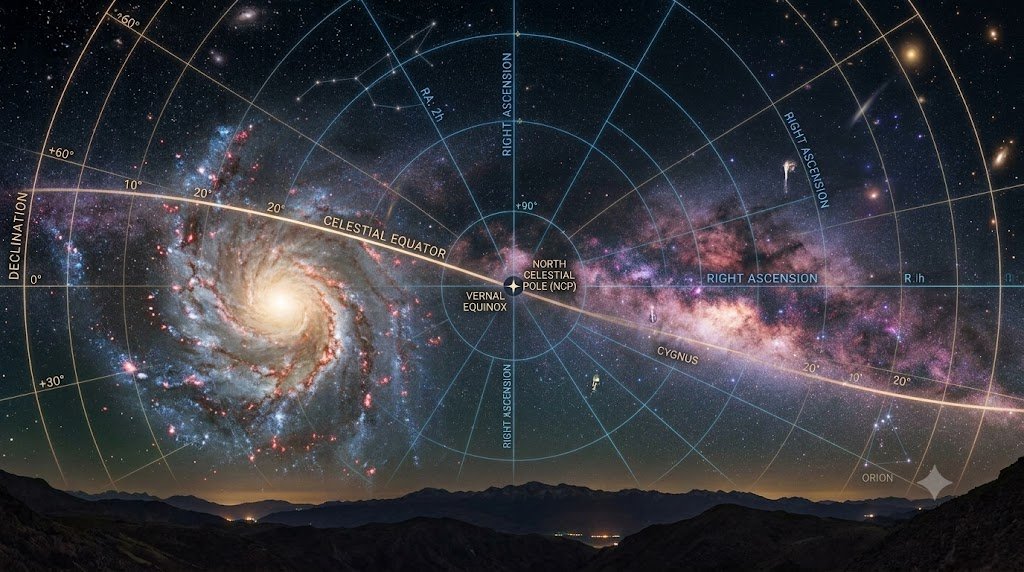
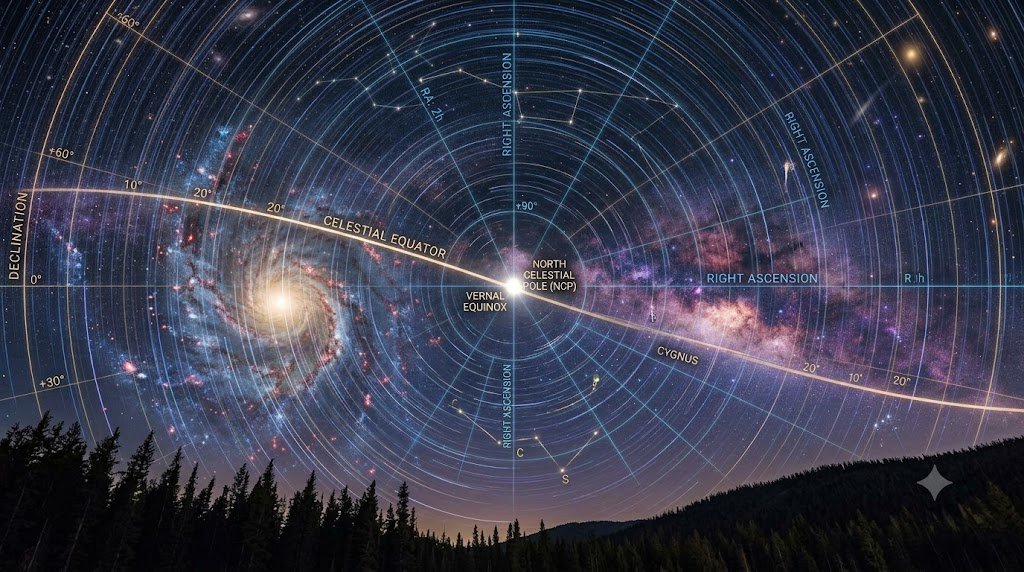
The Celestial Coordinate System: Right Ascension, Declination, and the Precession of Equinoxes

To an observer gazing upward into a pristine, unpolluted night sky, the universe appears as a colossal, rotating crystalline vault: an immense dome peppered with glistening stars, across which the Moon, planets, and Sun trace majestic, predictable paths. Since antiquity, humanity has sought to impose mathematical order upon this celestial expanse. Just as cartographers divide … Read more

Galaxy Clusters, Gravitational Lensing, and Large-Scale Cosmic Filaments: Mapping Dark Matter

When astronomers lift their gaze beyond individual galaxies and interacting pairs, they encounter the grandest, most gargantuan coherent structures bound by gravity in the history of the universe: Galaxy Clusters. Spanning tens of millions of light-years and containing hundreds to thousands of individual galaxies, trillions of stars, vast atmospheres of multi-million-degree X-ray gas, and enormous … Read more

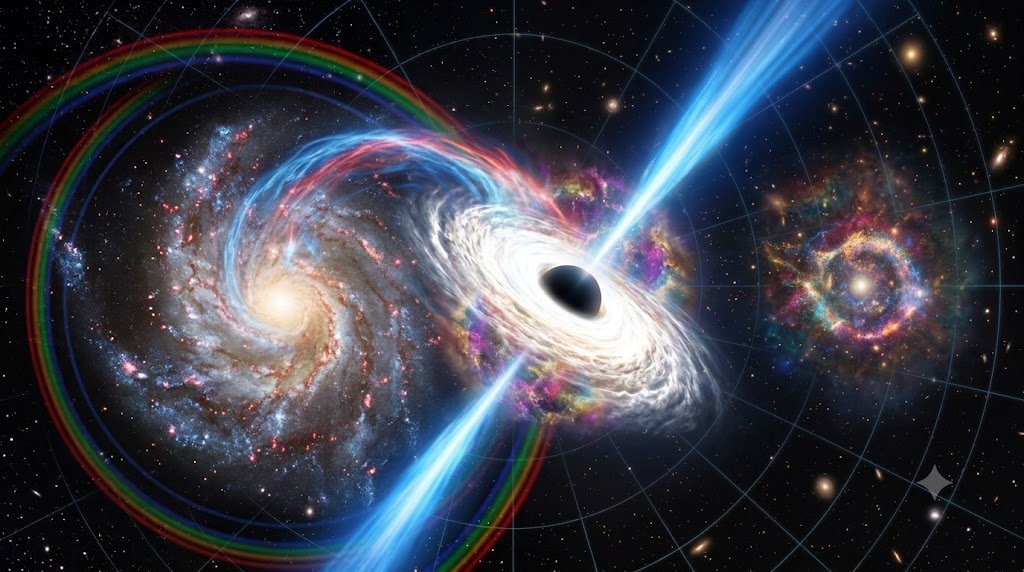
Active Galactic Nuclei and Quasars: Supermassive Black Hole Accretion Disks and Relativistic Jets

In the late 1950s, the advent of radio astronomy opened an entirely new window onto the cosmos, revealing mysterious celestial beacons emitting prodigious radio signals that appeared as ordinary, faint starlike points in optical telescopes. In 1963, Dutch-American astronomer Maarten Schmidt analyzed the optical spectrum of one such object, 3C 273, and made a paradigm-shattering … Read more

Galactic Morphology and the Hubble Tuning Fork: Spiral, Elliptical, and Irregular Architectures

Until the landmark observations of Edwin Hubble in the early 1920s at the Mount Wilson Observatory, the prevailing cosmological consensus held that the Milky Way encompassed the entirety of the observable universe. Faint, diffuse spirals observed through telescopes were dismissed as mere “spiral nebulae” situated within our own galactic boundaries. Hubble’s identification of Cepheid variable … Read more

Exoplanetary Detection and Habitability: Transit Photometry, Radial Velocity, and Bio-Signatures

Until the final decade of the twentieth century, humanity’s knowledge of planetary systems was restricted to the single, familiar architecture of our own solar system. For centuries, philosophers and astronomers debated whether planetary systems were ubiquitous cosmic structures or miraculous flukes of astronomical history. In 1995, Michel Mayor and Didier Queloz shattered that historical isolation … Read more

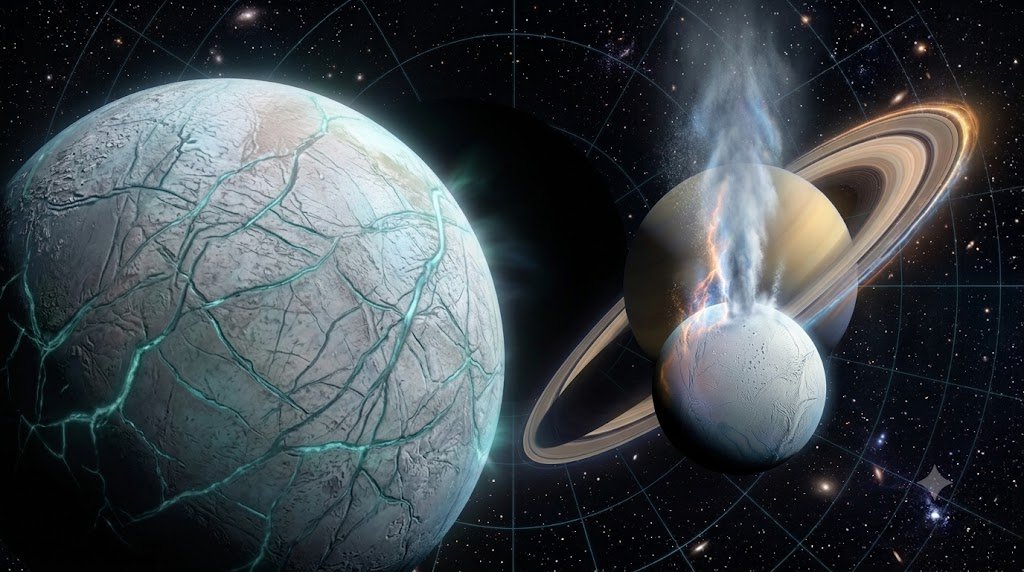
Moons of the Solar System: Tidal Heating, Subsurface Oceans, and Cryovolcanism

For centuries following the invention of the telescope, astronomers viewed the natural satellites of the outer planets as dead, frozen balls of rock and ice—cold relics suspended in perpetual deep freeze. That paradigm was shattered in March 1979 when Voyager 1 soared past Jupiter and photographed active volcanic plumes erupting hundreds of kilometers above the … Read more

The Gas and Ice Giants: Atmospheric Convection, Ring Dynamics, and Deep Magnetohydrodynamics

Beyond the asteroid belt and past the solar system’s primordial frost line lie the four colossal outer planets: Jupiter, Saturn, Uranus, and Neptune. Containing over 99% of all planetary mass in our solar system, these giant worlds are physical titans governed by fluid mechanics, extreme thermodynamics, and exotic states of matter impossible to recreate in … Read more

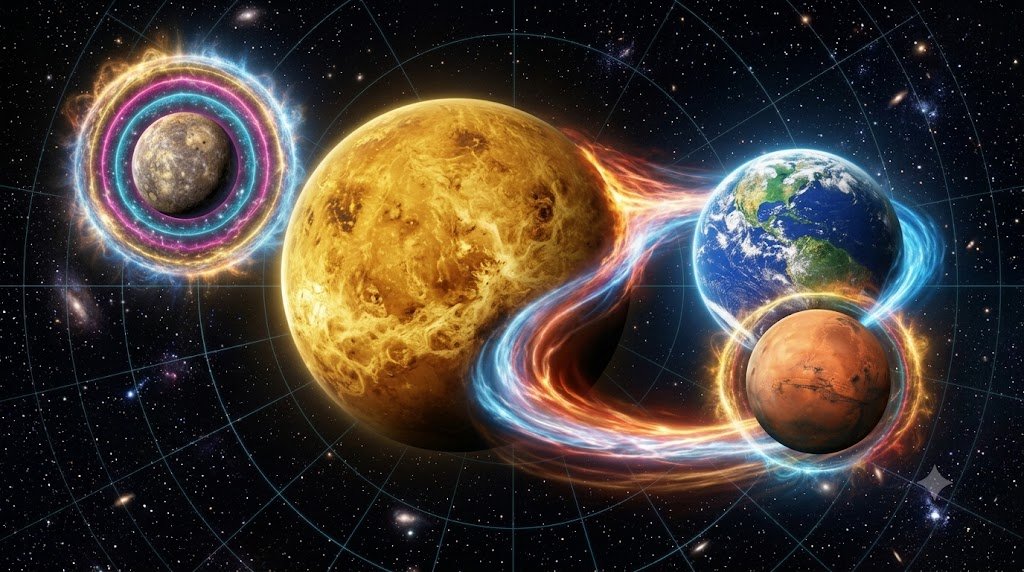
Comparative Terrestrial Planetology: Atmospheres, Geophysics, and Magnetospheres of Inner Worlds

In the inner solar system, within the frost line where volatile compounds could not condense into ice during the protosolar nebula epoch, four rocky worlds formed from the accretion of refractory silicates and metallic iron grains. Mercury, Venus, Earth, and Mars share a common cosmic pedigree, coalescing roughly 4.56 billion years ago from the same … Read more