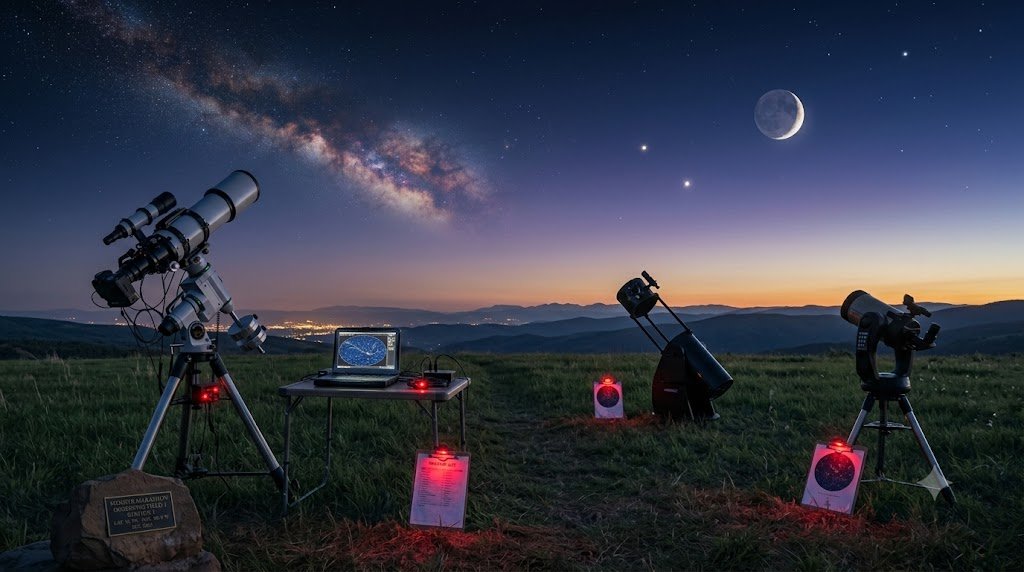
In the annals of observational amateur astronomy, there is no endurance challenge more iconic, thrilling, and grueling than the Messier Marathon. Conceived independently in the 1970s by American and European amateur astronomers, the Marathon challenges an observer to systematically locate, view, and log all 110 deep-sky objects cataloged by French astronomer Charles Messier in a single, continuous, dusk-to-dawn nocturnal observing session. Spanning glowing diffuse nebulae, planetary remnants, spectacular open star clusters, dense ancient globular clusters, and grand-design spiral galaxies, the Messier catalog constitutes a comprehensive greatest-hits anthology of the northern and equatorial sky. Yet completing a Messier Marathon is a formidable logistical and observational undertaking: it requires meticulous timing, mastery of celestial coordinates and star-hopping, rapid adaptation to optical challenges, and relentless stamina through twelve grueling hours of cold nocturnal darkness. This comprehensive treatise explores the historical genesis of Messier’s catalog, the celestial orbital mechanics that create the annual observing window, the chronological observing battle plan, and proven field strategies for completing all 110 objects.
1. Historical Genesis: The Frustrated Comet Hunter’s Catalog
The irony of Charles Messier’s immortal catalog is that Messier never set out to catalog deep-sky treasures for their own sake. In the late 18th century, Messier was an ambitious Parisian astronomer employed at the Hôtel de Cluny observatory. His primary professional obsession was hunting for comets—transient, icy interplanetary wanderers whose unpredictable appearances brought scientific prestige and royal honors.
Through the modest, un-achromatic 2-inch to 4-inch refracting and speculum-metal reflecting telescopes of the 1700s, faint deep-sky nebulae and distant unresolved star clusters appeared as small, fuzzy, whitish smudges—virtually indistinguishable from new comets. Night after night, Messier would excitedly spot a candidate comet, only to observe it for days and realize it remained completely motionless against the background stars.
Frustrated by these recurring optical false alarms, Messier began compiling a “nuisance list” of fuzzy objects that comet hunters should intentionally ignore! In 1758, while tracking Halley’s Comet, he logged his first entry: Messier 1 (M1), the luminous supernova remnant known as the Crab Nebula in Taurus. By 1781, with the collaboration of Pierre Méchain, his published catalog contained 103 objects (later expanded to 110 by 20th-century astronomers who added M104 through M110 based on Messier’s observational log notes). Messier’s list of celestial annoyances became humanity’s most cherished guidebook to the deep universe.
2. The Celestial Window: Why Mid-to-Late March?
Why can all 110 Messier objects be observed in a single night only during a specific two-week window in mid-to-late March? The answer lies in the orbital geometry of Earth around the Sun:
The Void in the Ecliptic
The 110 Messier objects are not distributed uniformly across the celestial sphere. Due to the orientation of our Solar System within the Milky Way, there is a fortuitous, wide gap in the Messier catalog located roughly between Right Ascension 21h 40m and 23h 20m in the constellations Aquarius, Capricornus, and Pegasus.
During the third and fourth weeks of March (near the Vernal Equinox), the Sun passes directly through this empty zone of the celestial sphere where no Messier objects reside! Consequently, when the Sun sets in the west, the earliest evening Messier objects (M74 and M77 in Pisces and Cetus) are still clinging to the western sky above evening twilight. Throughout the night, the clockwork rotation of Earth parades dozens of constellations overhead, culminating in the early morning dawn when the final Messier objects (M30 in Capricornus and M72/M73 in Aquarius) rise above the eastern horizon just before the morning sun blazes into view.
• Moon Phase Requirements: A Messier Marathon requires total nocturnal darkness. If a bright gibbous or full Moon is present, lunar skyglow will completely wash out faint galaxies in the Virgo Cluster and smudge low-altitude nebulae. A successful Marathon must be scheduled during a New Moon weekend between March 18 and March 28.
• Latitude Sweet Spot: The optimal geographic latitude for completing all 110 objects spans 15° N to 35° N (encompassing southern US states, Mexico, North Africa, the Middle East, India, and southern East Asia). Observers north of 45° N find southern targets (such as M55, M69, and M70) buried below their southern horizon, making a 110-object sweep physically impossible.
3. The Chronological Battle Plan: The Six Tactical Phases
A Messier Marathon is a race against the clock. The 110 objects cannot be observed at leisure; they must be hunted in a strict, pre-calculated chronological sequence dictated by celestial setting and rising times:
| Phase & Time Window | Key Constellations | Critical Target Objects | Tactical Challenge |
|---|---|---|---|
| Phase 1: Dusk Rush (19:30 – 21:00) |
Pisces, Cetus, Andromeda, Triangulum, Pegasus | M74, M77, M31, M32, M110, M33 | High stress! M74 and M77 set rapidly in bright evening twilight. Miss them in the first 45 minutes and the 110-object sweep is lost. |
| Phase 2: The Winter Showcase (21:00 – 23:30) |
Taurus, Orion, Auriga, Gemini, Canis Major, Puppis | M1, M42, M43, M45, M35, M36, M37, M38, M41, M46, M47 | Rapid-fire scoring! High, bright, spectacular open clusters and nebulae. Observers can log 30+ objects in under two hours. |
| Phase 3: The Northern Tour (23:30 – 01:00) |
Ursa Major, Canes Venatici, Leo, Cancer | M81, M82, M51, M101, M65, M66, M44 (Beehive) | Prime high-contrast galaxies near zenith. Relaxed pace with bright Messier showpieces. |
| Phase 4: The Virgo Galaxy Maze (01:00 – 03:30) |
Virgo and Coma Berenices | M49, M58, M59, M60, M84, M86, M87, M88, M89, M90, M98, M99, M100 | The infamous “Galaxy Gauntlet”! 16 faint, identical-looking elliptical and spiral galaxies crammed into a 10-degree patch. Star-hopping charts are essential to avoid misidentifying targets. |
| Phase 5: The Midnight Rest & Globular Stampede (03:30 – 04:45) |
Hercules, Ophiuchus, Scorpius, Sagittarius | M13, M92, M10, M12, M4, M80, M6, M7 | A mandatory 30-minute coffee/hot food break while waiting for Sagittarius to rise, followed by sweeping dozens of rich globular clusters. |
| Phase 6: The Dawn Sprint (04:45 – 05:45) |
Sagittarius, Capricornus, Aquarius, Pegasus | M8, M20, M16, M17, M55, M75, M72, M73, M30 | The ultimate climax! Battling morning astronomical twilight. M30 rises barely 10 degrees above the southeastern horizon as the sky turns blue. Finding M30 seals the 110/110 victory! |
4. Navigating the Virgo Cluster: Surviving the Galaxy Gauntlet
Phase 4 in the Virgo-Coma cluster represents the primary bottleneck where marathons are won or lost. In a wide-field finderscope, dozens of faint smudges appear simultaneously. To navigate without getting lost, seasoned observers employ Markarian’s Chain:
1. Begin by identifying the bright star Denebola (β Leonis) and Vindemiatrix (ε Virginis). The core of the Virgo Cluster sits precisely midway between them.
2. Locate the giant elliptical pair M84 and M86. These two bright galaxies form the anchor of Markarian’s Chain—a graceful curving arc of eight interacting galaxies stretching across 1.5 degrees of sky.
3. Sweep systematically eastward along the arc to log M87 (the giant radio galaxy), then step northward to M88, M90, and M89.
4. Cross-check your field of view against a detailed, inverted finder chart printed at 1:1 scale with your eyepiece field stop. Never guess: verify galaxy shapes (edge-on spiral vs. round elliptical) to guarantee accurate logging.
5. Equipment Optimization: Finding the Perfect Marathon Rig
Selecting the optimal telescope for a Messier Marathon involves very different criteria than planetary viewing or long-exposure astrophotography:
• Recommended Aperture (6″ to 10″ / 150 mm to 250 mm): A 4-inch telescope struggles with faint, low-altitude morning galaxies like M74 and M76 under slight atmospheric haze. A 16-inch Dobsonian is magnificent, but its narrow field of view and heavy bulk slow down rapid panning. A 8-inch (200 mm) f/5 Dobsonian or Newtonian represents the golden mean: lightweight, wide field of view, and abundant light grasp to make every Messier object unmistakable.
• Dual Finder Setup: Pair an unmagnified illuminated reflex sight (such as a Telrad or Rigel QuickFinder) with an 8×50 right-angle correct-image (RACI) optical finderscope. The Telrad points you to the general star field in 2 seconds; the RACI optical finder reveals 9th-magnitude guide stars matching your paper atlas without straining your neck.
• Manual Star-Hopping vs. Computerized GoTo: While traditional purists insist on manual star-hopping using paper charts, computerized GoTo telescope mounts and digital setting circles (Push-To) are fully permitted in modern club marathons. GoTo saves critical minutes in the Virgo Cluster and allows the observer to focus entirely on visual verification and note-taking.
6. Field Survival Strategies: Physical and Mental Endurance
Observing continuously for twelve hours in sub-freezing March nocturnal temperatures places severe physical demands on the human body. Veteran marathoneers rely on strict field routines:
| Challenge | Field Threat | Proven Solution |
|---|---|---|
| Hypothermia & Windchill | Standing motionless at the eyepiece rapidly saps core body heat; shivering degrades fine optical focusing | Layering system: thermal merino wool base layer, fleece mid-layer, windproof ski parka, insulated snow boots (rated -20°C), fingerless gloves with flip-over mittens, and chemical hand-warmers in pockets |
| Optical Dewing | Dew forms on finder objectives, secondary mirrors, and eyepieces around 01:00, halting observation completely | Active 12V dew heaters on finderscope and primary/secondary optics; keep spare eyepieces in warm insulated cases inside heated vehicle |
| Circadian Fatigue Crash | The infamous 03:00 to 04:00 fatigue wall: eyelids droop, concentration evaporates, visual acuity drops 50% | Take a 20-minute power nap between Phase 4 and Phase 5; consume high-protein snacks (nuts, jerky) and warm herbal tea or black coffee from a thermos; avoid sugary energy drinks that trigger a severe glycemic crash |
| Loss of Dark Adaptation | Accidental white-light flashlight use resets biological rhodopsin, blinding the eye to faint Virgo galaxies | Tape red cellophane or rubylith over all red flashlights to ensure minimal brightness; adjust red headlamps to lowest lumen mode |
7. Logging, Verification, and Certificate Honors
A Messier Marathon is an official astronomical endeavor recognized by national astronomical bodies around the globe, including the Astronomical League (Messier Observers Club) and the Royal Astronomical Society of Canada (RASC).
To earn official recognition and certificate honors, keep an organized log sheet recording:
• Object Catalog Number: (e.g., M42, M51, M87)
• Time Observed: Precise local time (hh:mm)
• Instrument & Magnification: (e.g., 8″ Dobsonian @ 48x and 120x)
• Visual Description: A concise sentence describing core brightness, halo shape, stellar resolution, or field stars (e.g., “M13: Brilliantly resolved globular cluster with hundreds of pinpoint stars resolved to the core, three outer propeller-like star chains visible”).
8. The Great Non-Messier Showpieces: The Double Cluster and the Caldwell Catalog
While the Messier Marathon focuses strictly on Messier’s 110 targets, every experienced observer notes with amusement the magnificent celestial treasures Messier curiously omitted. Prominent among these is The Double Cluster in Perseus (NGC 869 and NGC 884)—two glittering jewel boxes of sparkling supergiant stars visible to the naked eye that easily rival any open cluster on Messier’s list.
In 1995, British astronomer Sir Patrick Moore compiled the Caldwell Catalog of 109 deep-sky objects specifically designed to complement Messier by including brilliant non-Messier northern showpieces and spectacular southern hemisphere gems (such as the Eta Carinae Nebula C92 and Omega Centauri C80). Observers who master the Messier Marathon frequently advance to the Caldwell Marathon, continuing the lifelong adventure of exploring the cosmic vault.
9. The Spirit of Community: Star Parties and Nocturnal Camaraderie
Ultimately, a Messier Marathon is far more than a technical checklist; it is a shared cultural ritual that unites astronomers worldwide. Under the canopy of unpolluted rural skies, dozens of observers huddle together against the cold, sharing warm drinks, trading star-hopping tips, and cheering each other through the grueling midnight fatigue. As the final sliver of morning twilight brightens the eastern sky and the elusive glow of M30 is confirmed in the eyepiece, an overwhelming sense of accomplishment washes over the field. You have witnessed the entire tapestry of the deep universe in a single continuous voyage: from the stellar nurseries where suns are born to the ancient galactic swarms that anchor cosmic spacetime. The Messier Marathon is more than an observing test; it is humanity’s ultimate nocturnal odyssey under the starry vault of heaven.