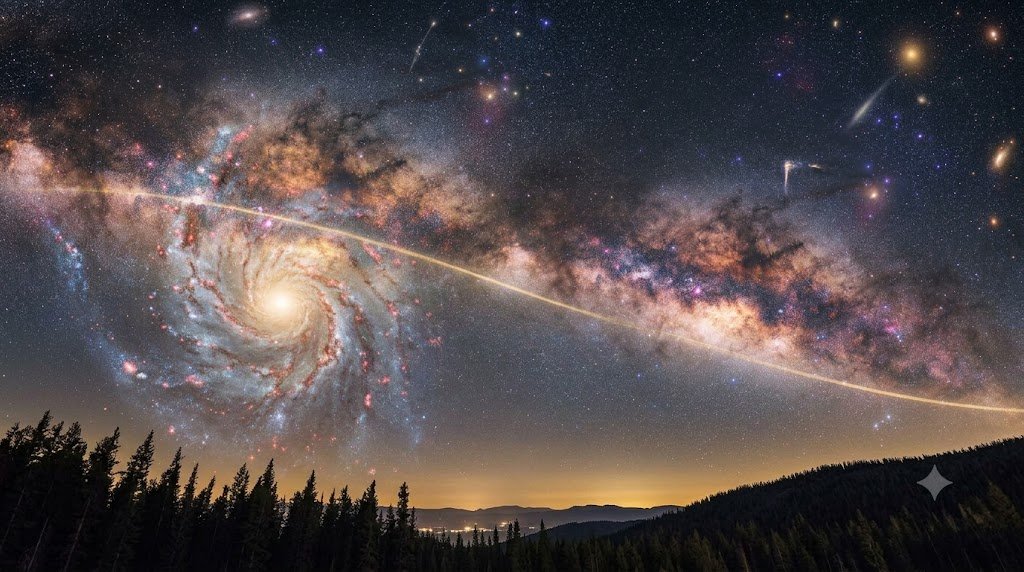
Across all ancient cultures, no sector of the nocturnal sky captivated stargazers more profoundly than the narrow celestial highway traversed by the Sun, Moon, and planets. To the Babylonians, Egyptians, Greeks, and Vedic astronomers, this golden ribbon was the Zodiac—literally the “circle of animals”—a belt of constellations framing the immutable cosmic choreography of the Solar System. While ancient astrology assigned mystical interpretations to these stellar groupings, modern astrophysics recognizes the Zodiac as a profound geometric consequence of planetary orbital co-planarity, established during the primordial collapse of the protoplanetary nebula 4.6 billion years ago. Furthermore, because the Zodiac spans the intersection of the galactic plane, it harbors an extraordinary wealth of deep-sky astrophysical wonders: newborn open star clusters, violent supernova remnants, and colossal stellar nurseries. This comprehensive treatise investigates the orbital geometry of the Ecliptic, the astronomical reality of the thirteen zodiacal constellations, precession-driven zodiacal shifts, planetary retrograde motion, and the deep-sky masterworks of the zodiacal path.
1. Orbital Geometry: Why the Ecliptic Exists
To understand the Zodiac, one must understand why our Solar System is flat. In the primordial epoch 4.56 billion years ago, the protosolar nebula collapsed under its own gravity. As the cloud contracted, conservation of angular momentum forced the spinning gas and dust to flatten into a thin, spinning Protoplanetary Disk. The planets coalesced within this disk; consequently, all major planets orbit the Sun within nearly the exact same geometric plane.
• The Ecliptic Plane: The geometric plane defined by Earth’s orbit around the Sun. From our moving terrestrial perspective, the Sun appears to trace this exact 360-degree circle against the background stars over the course of one tropical year.
• The Invariable Plane: The true dynamical angular momentum plane of the Solar System, dominated by Jupiter (inclined by just 1.57° to the Ecliptic).
• The Zodiacal Belt: A celestial band extending approximately 8 to 9 degrees above and below the Ecliptic. Because the orbital inclinations of the Moon and major planets (Mercury: 7.0°, Venus: 3.4°, Mars: 1.85°, Jupiter: 1.3°, Saturn: 2.5°) are small, they never wander outside this narrow zodiacal ribbon.
| Constellation | IAU Sun Dates (Astronomical) | Sun Span (Days) | Brightest Star (Alpha) | Premier Deep-Sky Wonder |
|---|---|---|---|---|
| Aries | Apr 18 – May 13 | 25 days | Hamal (α Ari, mag 2.00) | NGC 772 (Spiral Galaxy) |
| Taurus | May 13 – Jun 21 | 38 days | Aldebaran (α Tau, mag 0.85) | M45 (Pleiades), M1 (Crab Nebula) |
| Gemini | Jun 21 – Jul 20 | 31 days | Pollux (β Gem, mag 1.14) | M35 (Open Cluster), Eskimo Nebula |
| Cancer | Jul 20 – Aug 10 | 20 days | Tarf (β Cnc, mag 3.52) | M44 (Beehive Cluster / Praesepe) |
| Leo | Aug 10 – Sep 16 | 37 days | Regulus (α Leo, mag 1.35) | Leo Triplet (M65, M66, NGC 3628) |
| Virgo | Sep 16 – Oct 30 | 45 days (Longest) | Spica (α Vir, mag 0.98) | Virgo Cluster of Galaxies (M87) |
| Libra | Oct 30 – Nov 23 | 23 days | Zubeneschamali (β Lib, mag 2.61) | NGC 5897 (Globular Cluster) |
| Scorpius | Nov 23 – Nov 29 | 6 days (Shortest) | Antares (α Sco, mag 0.96) | M4, M6 (Butterfly), M7 (Ptolemy) |
| Ophiuchus | Nov 29 – Dec 17 | 18 days (The 13th Sign) | Rasalhague (α Oph, mag 2.08) | Barnard’s Star, Rho Ophiuchi Cloud |
| Sagittarius | Dec 17 – Jan 20 | 32 days | Kaus Australis (ε Sgr, mag 1.79) | Galactic Center Sgr A*, M8 (Lagoon), M20 |
| Capricornus | Jan 20 – Feb 16 | 28 days | Deneb Algedi (δ Cap, mag 2.85) | M30 (Globular Cluster) |
| Aquarius | Feb 16 – Mar 11 | 24 days | Sadalsuud (β Aqr, mag 2.90) | Helix Nebula (NGC 7293), Saturn Nebula |
| Pisces | Mar 11 – Apr 18 | 38 days | Alpherg (η Psc, mag 3.62) | M74 (Grand Design Spiral Galaxy) |
2. The Thirteen Astronomical Constellations of the Zodiac
A profound chasm exists between classical astrological conventions and modern physical astronomy. Over 2,500 years ago in ancient Babylon, astronomers divided the 360-degree circle of the ecliptic into twelve equal geometric segments of exactly 30 degrees each, assigning each segment a constellation name. However, real constellations on the celestial sphere are irregular, naturally varied polygons with vastly different widths.
Ophiuchus: The Thirteenth Constellation
When the International Astronomical Union established precise official boundaries in 1928, the Ecliptic was proven to pass through thirteen distinct constellations. Immediately following Scorpius, the Sun travels for eighteen full days (from November 29 to December 17) through the southern reaches of Ophiuchus, the Serpent Bearer. In fact, the Sun spends triple the amount of time traversing Ophiuchus (18 days) than it spends traversing Scorpius (barely 6 days)!
Precession and the Astrological Shift
Furthermore, because of Earth’s 25,772-year axial precession, the intersection of the celestial equator and the ecliptic (the Vernal Equinox) has drifted westward along the zodiac by almost 36 degrees since Babylonian times. When astrology was codified around 500 BCE, the Sun was in Aries during the March equinox (giving rise to the phrase “First Point of Aries”). Today, the Vernal Equinox has precessed into Pisces, and will cross the border into Aquarius in the twenty-seventh century. Consequently, the astronomical constellation in which the Sun resides on any given birthday is offset by nearly a full month from traditional astrological signs.
3. Planetary Kinematics: Retrograde Loops and the Copernican Revolution
Normally, planets wander through the zodiacal constellations from west to east—a motion called prograde motion. However, for centuries, astronomers struggled with a bizarre observational enigma: periodically, outer planets like Mars, Jupiter, and Saturn slow to a halt (stationary point), reverse direction, and travel eastward to westward for several weeks (Apparent Retrograde Motion), tracing an S-shaped or loop-like trajectory across the zodiac before resuming normal forward motion.
• The Ptolemaic Geocentric Nightmare: Claudius Ptolemy was forced to invent an intricate, cumbersome apparatus of deferents and epicycles (wheels within wheels revolving on imaginary geometric axes) to explain retrograde loops around a stationary Earth.
• The Copernican Heliocentric Triumph: In 1543, Nicolaus Copernicus showed that retrograde motion is an elegant optical perspective illusion. Earth orbits closer to the Sun and travels faster along its orbit (29.8 km/s) than outer planets like Mars (24.1 km/s). As faster Earth laps a slower outer planet on an inside orbital track, the outer planet appears to temporarily drift backward against the distant background zodiacal stars, exactly like a slower car appears to move backward when overtaken on a highway!
4. Deep-Sky Wonders Embedded along the Zodiac
Because the Ecliptic crosses directly through the star-rich plane of the Milky Way in Taurus and Sagittarius, the zodiac is illuminated by some of the most spectacular deep-sky objects in astrophysics:
Taurus: The Pleiades (M45) and the Crab Nebula (M1)
The constellation Taurus harbors two historic masterworks at opposite ends of the stellar life cycle. The Pleiades (M45, the Seven Sisters) is a dazzling open star cluster located 444 light-years away, containing over 1,000 young, luminous B-type stars formed barely 100 million years ago, swathed in an ethereal blue reflection nebula of interstellar dust.
At the eastern tip of Taurus sits The Crab Nebula (M1)—the expanding supernova remnant of a colossal core-collapse supernova observed and recorded by Chinese and Arab astronomers on July 4, 1054 CE. At its center spins the Crab Pulsar: a super-dense neutron star rotating 30 times per second, energizing an intense synchrotron nebula through high-energy particle acceleration.
Cancer: The Beehive Cluster (M44)
In the faint constellation Cancer lies Messier 44 (Praesepe / The Beehive Cluster). Easily visible to the naked eye as a ghostly, misty cloud, M44 is an open star cluster spanning 610 light-years away. It contains roughly 1,000 stars sharing an identical age and space motion with the Hyades cluster in Taurus, suggesting both clusters formed from the same massive giant molecular cloud roughly 600 million years ago.
Sagittarius: The Gateway to the Galactic Core
Sagittarius is the crown jewel of the zodiac. Looking into Sagittarius means gazing directly toward the center of the Milky Way. This rich sector contains an unrivaled concentration of radiant emission nebulae, including The Lagoon Nebula (M8)—a titanic stellar nursery spanning 110 light-years across—and The Trifid Nebula (M20), famous for its striking juxtaposition of a pink emission nebula divided by three dark dust lanes, set against a glowing blue reflection nebula.
5. Zodiacal Light and False Dawn: Interplanetary Dust Scattering
On clear, moonless nights in spring after evening twilight, or in autumn before morning dawn, stargazers in dark-sky locations can observe a faint, glowing pyramid of ghostly pearlescent light rising along the ecliptic: the Zodiacal Light (historically called the “False Dawn”).
Astrophysicists confirmed that this ethereal glow is not atmospheric. Rather, it is caused by sunlight scattering off trillions of microscopic dust grains populating the interplanetary dust cloud along the ecliptic plane. Data from NASA’s Juno spacecraft revealed that the primary source of this zodiacal dust is not comets or collisions in the asteroid belt, but dust shed during intense dust storms on the planet Mars. The Zodiac is an interconnected dynamic ecosystem: a cosmic highway where planetary orbits, interplanetary dust, stellar evolution, and ancient human curiosity unite across the celestial vault.
6. The Gegenschein: The Counter-Glow at the Antisolar Point
At the exact opposite point from the Sun in the midnight sky lies an even fainter, more elusive companion to the zodiacal light: the Gegenschein (German for “Counter-Glow”). Spanning roughly 8 to 10 degrees across in the zodiacal constellation currently culminating at midnight, the Gegenschein is an oval patch of soft luminescence created by backscattering (opposition surge) of sunlight from interplanetary dust particles orbiting beyond Earth’s orbit.
Because dust particles at the antisolar point are viewed at a phase angle of zero degrees, shadows cast by microscopic surface irregularities vanish, causing a dramatic increase in reflected light efficiency. Observing the Gegenschein requires exceptional dark skies (Bortle Class 1 or 2) and full dark adaptation, standing as one of the ultimate visual rewards of observational astronomy.
7. The 13th Constellation: The Astronomical Reality of Ophiuchus
While traditional astrological charts stubbornly divide the ecliptic into twelve equal 30-degree segments, the astronomical reality defined by the International Astronomical Union (IAU) in 1930 includes a thirteenth constellation: Ophiuchus (The Serpent Bearer).
The ecliptic passes through the southern boundary of Ophiuchus between November 29 and December 17—a duration of nearly three weeks. In fact, the Sun spends more time traversing Ophiuchus (18 days) than it does passing through the neighboring zodiacal constellation Scorpius (barely 7 days). Ophiuchus contains profound astrophysical treasures, including Barnard’s Star—a red dwarf boasting the largest known stellar proper motion (10.3 arcseconds per year)—and Kepler’s Supernova Remnant (SN 1604), the last naked-eye supernova observed within our own galaxy.
8. Planetary Conjunctions and Rare Great Alignments
Because the planets of our solar system are confined within the narrow band of the Zodiac, their intersecting orbital periods produce breathtaking optical events known as Planetary Conjunctions. When two or more planets appear closely grouped together in the sky along the ecliptic, they create stunning celestial tableaux. The most famous is the Great Conjunction of Jupiter and Saturn, occurring once every 19.6 years as swift Jupiter overtakes slower-moving Saturn.
During the historic Great Conjunction of December 21, 2020, Jupiter and Saturn approached within a mere 0.1 degrees of each other in the constellation Capricornus, allowing both giant planets and their retinue of Galilean and Saturnian moons to be viewed simultaneously within the same high-power telescope eyepiece field of view. Understanding the geometry of the zodiacal highway elevates astronomy from a passive viewing experience to an active engagement with the living, clockwork orbital mechanics of our Solar System.
Modern IAU Coordinate Boundaries and Precessional Drift
In modern observational astrophysics, the International Astronomical Union (IAU) formally demarcated the official celestial boundaries of all 88 constellations in 1930 under the direction of Belgian astronomer Eugène Delporte. Along the ecliptic plane, these precise boundaries revealed that the Sun actually traverses thirteen constellations throughout the tropical year rather than the traditional twelve. The thirteenth constellation, Ophiuchus (the Serpent Bearer), hosts the Sun for eighteen days between late November and mid-December, situated between Scorpius and Sagittarius.
Furthermore, axial precession—the gradual gravitational wobble of Earth’s rotational axis with a period of approximately 25,772 years—causes the vernal equinox to continuously drift westward along the ecliptic at a rate of 50.3 arcseconds per year. Consequently, astronomical coordinates must be systematically referenced to standardized epochs, such as the current standard J2000.0 epoch, enabling backyard observers and computerized equatorial telescope mounts to locate zodiacal deep-sky treasures with sub-arcminute pointing accuracy.